Showing posts with label Ben Sutton. Show all posts

Thursday, May 20, 2010

Julie Mehretu: Capitalizing on Smooth Capital


During our final evening together (and, indeed, throughout the semester and on this blog) the concepts of smoothness and striation have been especially fruitful, most recently in the presentations by Raul and Vanessa, for instance, partly I think because of the relatively clear visual analogies that they conjure up–to, say, the smooth ocean and the striated urban grid–while related terms like becoming and being remain more abstract. Our understanding of these opposite yet always contiguous if not overlapping notions of smoothness and striation become partly unsettled (or... smoothed?) when Deleuze and Guattari make the further distinction in A Thousand Plateaus (1980) that now, at the "dominant level of integrated (or rather integrating) world capitalism, a new smooth space is produced in which capital reaches its 'absolute' speed, based on machinic components rather than the human component of labor" (492). We addressed this capitalist version of smoothness briefly in class, attributing it to new forms of capitalism that have emerged in the last 30 to 40 years, types of capitalist societies and cultures in which the multinational corporation replaces the State as the dominant agent of control. What makes contemporary global capitalism smooth rather than striated, from what I understand, is that it constantly offers more, and at greater speeds. As an undergraduate professor once put it to me, very helpfully: Whereas pre-capitalist societies and early forms of capitalism said "No," contemporary global capitalism always says "Yes." Though this much is clear, and fairly intuitive, I began to wonder (as this is a question that came up as I was writing my final paper) how we might represent this absolutely smooth capitalism that is constantly in the process of becoming smoother. Having just seen the new exhibition of large-scale mixed media canvases by Julie Mehretu at the Guggenheim, Grey Area (through October 6), her work immediately struck me as one of the most well-developed and eloquent representations of this smooth capitalism in contemporary art. The fact that the works were commissioned by a global bank, Deutsche Bank, adds a further irony to this fact.

Mehretu is an American artist who was born in Ethiopia in 1970, her work consists of large-scale drawings, collages and paintings that she composes as separate layers first on a computer, then projects these digital images onto her massive canvases (each of the six pieces in this exhibition are 11 feet tall and 14 feet wide) and applies a range of materials from acrylic paints and ink to pencil and strips of paper, each in successive layers. Once the different levels (sometimes as many as six) are applied and fixed she makes more gestural, expressionist additions to the final composition. In this exhibition she rubbed and scraped certain areas, creating ghostly patches of erasure, destruction and absence. The resulting compositions are spectacularly busy yet almost infinitely zoom-able; that is, the level of detail in Mehretu's work is such that one can focus on a very small section of any piece and still have more than enough details and layers to tease apart. The super-imposed patterns in each piece include: architectural vectors of virtually every style of building, from classical and Renaissance structures to modern skyscrapers, airports and stadiums; pointillist ink blots that often cluster to evoke flocks of birds or swarms of insects; narrow strips of acrylic paint in neon and pastel hues that, though very subtle, direct the viewers' eyes with sharp diagonal lines; thicker bands and geometric forms of cut-out paper that often bend, curve and loop, suggesting cyclical patterns rather than unidirectional movements; and soft, transparent, cloud-like areas of primary colors.


The very affecting visual challenge in much of her work, at least initially, is to distinguish the various superimposed layers and then understand the myriad ways in which they do or don't work together, continuing and complimenting each other's forms and dimensions. Her process of superimposition, in which the architectural diagrams are always the bottom layer, the first one applied, evokes Deleuze and Guattari's comment that "when the striated attains its ideal of perfect homogeneity, it is apt to reimpart smooth space" (488). In Mehretu's work, the most striated elements, these architectural drawings, seem to give shape to the smoother forms at play above, as if this fundamental architectonic groundwork were necessary to give rise to the churning, slipping and swarming layers that come after. In her work, striation always precedes smoothness in much the same way that striated capital necessarily preceded smooth capital. Her compositions are extremely fluid despite their many rectilinear components. There is often a predominant flow or movement to each piece, whether sweeping across the canvas or swirling in circular currents, but within isolated sections it's nearly impossible to discern a specific direction or perspective. Each composition is made up of seemingly infinite elements and multiple layers that nevertheless contribute to an overarching system that is dazzling, polysemic and unquantifiable. In this respect, Mehretu's work offers what seems to me a very appropriate and nuanced visual representation of the type of smoothness being perpetually generated, expanded and amplified by contemporary global capitalism. Both are impossibly complex systems made up of qualitatively distinct elements–some of which seem smooth while others are irrevocably striated–that nonetheless make up extremely dynamic and smooth forms. Part of what makes contemporary global capitalism so insidious is the way in which it seems to evade representation and resistance by being in a constant state of change of acceleration. Mehretu, it seems to me, manages to convey this process of never-ending renewal, flux and expansion, and with spectacular clarity.

-Ben Sutton

Wednesday, May 12, 2010

Smoothing Out Striations: The Art of Cyprien Gaillard


Tonight I'll be making a presentation on the work young French conceptual artist Cyprien Gaillard, whose practice includes video, performance, sculpture, photography and land art. I'll mainly be discussing his video art, which is what he's best known for, and its relationship to architecture, and how his work activates many concepts we've discussed throughout the semester, particularly pertaining to Deleuze and Guattari's concepts of the smooth and the striated.

You can read a recent essay by Gaillard in ArtForum, wherein he discusses his interest in modern ruins, and watch the following video, Pruitt-Igoe Falls (2009), his second-most famous work to date (I'll be discussing his best-known as well, which only exists online in impoverished snippets, but you may have seen at the New Museum last year in The Generational: Younger Than Jesus, and is discussed at great length here). I will also show it in class this evening. See you then.

-Ben Sutton


Friday, May 7, 2010

Hansen, Virtual Reality and Video Games


During our discussion on Wednesday one of the major shortcomings we found in Mark B. N. Hansen's New Philosophy for New Media (2006) was the absence of any engagement with video games. This struck us as especially problematic since his whole project seemed to be a consideration of the ways that qualitatively new media allow us to engage with them in an affective, embodied manner, and this certainly sounds like the kind of experience we have whenever we play a video game, be it an old coin-operated Pacman arcade game or a brand new Wii game at home or World of Warcraft on a computer. Surely Hansen would not be able to liken this activity to the so-called "enforced passivity" of the cinema that he seems so resolved to criticize. But then how would he be able to maintain a distance (as he would presumably want to do) between the work of Jeffrey Shaw that he is so committed to, and something like Second Life, Halo, or even Tetris? I think we might extract and extrapolate some (relatively positive) evaluation of video games from Hansen's critique of Liev Manovich's The Language of the New Media (2001), and the treatment of virtual reality (VR) therein, near the end of chapter one of New Philosophy for New Media.

In this passage Hansen criticizes Manovich's evaluation of VR for failing to fully take into account the embodied experience of the user during and despite the experience of being also virtually embodied, or virtualized. He asks: "Can the reality effect of telepresence be understood without an account of the physicality of the virtualized body?" (40-41) He suggests, in other words, that new media such as VR enable the user to be doubly embodied, both in the "original" space of the virtualizing interface or console and within the virtual world, in a digitized body. While Manovich suggests that the latter nullifies the former for the duration of the VR experience, Hansen argues that both must be partial and simultaneous, leading him to propose what seems a very radical (and very Deleuzian) realignment of the conventional opposition between representation and simulation, one that can be useful for constructing a Hansenian theory of the video game. He writes of Manovich: "the example of telepresence underscores the limitations of his general distinction between representation and simulation and suggests the necessity of triangulating this binary with a third term, namely, hallucination (by which I mean... that the embodied mind actually creates what it sees)" (41, emphasis original). One final quotation (in which we might substitute "video game" for "VR" to fully understand how these comments apply to the former medium): "that explains the capacity for the VR interface to couple our bodies with (almost) any arbitrary space, and not just spaces that are contiguous with the physical space we happen to occupy or even spaces like those we typically occupy" (41). This triangulating, hallucinatory property that Hansen invests in VR can very easily be seen as the starting point for his (perhaps surprisingly positive) evaluation of video games.

Video games, like VR, must then trigger this phenomenon of being in a doubly embodied, hallucinatory state, activating a virtualized world while still remaining an affective body within the world of the gaming interface. Certainly the increasingly frequent appearance of artist-designed video games in art spaces corroborates this characterization. In the exhibition The Generational: Younger Than Jesus at the New Museum last year, video game artist Mark Essen presented a game of his called Flywrench (2007), in which the player uses a controller to navigate a flying wrench through a series of increasingly labyrinthine spaces while trying to keep the fragile object from shattering. The unique telepresence of this game takes us to an environment that is certainly not "like those we typically occupy," requiring us to assume the position of a typically inanimate object (a wrench) endowed with the superhuman ability of flight. Playing the game, however, also meant standing in a museum gallery (there was no seating, perhaps to discourage visitors for hogging the one controller for too long) surrounded by other visitors, some of whom might be watching you play, hearing sounds from nearby installations and videos. Perhaps not an ideal gaming environment, the Flywrench installation illustrated Hansen's phenomena of triangulation and hallucination in a decidedly active, rather than passive, setting.

An installation at last spring's Offf Festival by the Spanish design firm Multitouch Barcelona pushed this capacity for simultaneous, multiple embodiments to the extreme, creating a wall-sized projection of the vintage arcade game Space Invaders (see video at the end of this post). Gallery-goers played the game not by pushing buttons on a controller or joystick, but by throwing projectiles like tennis balls at the projected images on the wall, where a sensory surface detected the hit, destroying the enemy ship, if there was one, in that spot. Anything but passive, this throwing game has the further advantage of being a multi-player experience, adding a sense of temporary, communal embodiment very different from the solitary VR experience that Hansen describes.

Another video game artist, Erik Svedang, has created a very immersive, but just as graphically simple gaming environment called Pixel Cave Adventure (2007, pictured at top), in which gamers play within a small cube surrounded by four screens, directing a small human figure who moves around the panoramic maze surrounding the player. Parallels to the work of Jeffrey Shaw, as discussed by Hansen, are inevitable, though here the simultaneity of embodiments is perhaps more extreme, allowing the gamer to control a solitary humanoid character while at the same time having to move and turn around in the claustrophobic space of the gaming cube.

These examples of how we might imagine Hansen's hallucinatory theory of VR being applied to video games all involve site-specific installations, but a simpler game that exists online for free might demonstrates the VR-video game analogy as well. First-Person Tetris begins much like the original game, presenting the gamer with a vertical, rectangular space and falling blocks that must be arranged to create solid lines. The space of the game is surrounded by a conventional living room setting with television, carpeting, a houseplant and video game console. But as the pieces move downwards so does the entire screen. Rotating pieces to fit them into the increasingly complex geometric gaps makes the entire screen rotate. As the game's title suggests, we are challenged to assume the point of view of these abstract blocks of forms and color, a perspective that stands in sharp contrast to our embodied presence in front of a computer screen. Aside from provoking a surprisingly acute sense of Hansen's hallucinatory double embodiment, First-Person Tetris is liable to provoke nausea, pushing our capacity to inhabit both the virtualized and physical spaces at once nearly to its breaking point. Such innovative video games offer extremely interesting and promising activations of Hansen's concept of multiple embodiments and the hallucinatory relation between representation and the virtual in VR. Though he never addresses the potential of video games for triggering qualitatively new experiences and embodiments, we can surmise of his engagement with VR that he may have identified a surprisingly optimistic potential in this new medium.

-Ben Sutton

Here is a short video of the interactive, wall-sized Space Invaders projection by Multitouch Barcelona at the 2009 Offf Festival:

Tuesday, May 4, 2010

In Defense of Narrative


Throughout the semester, but particularly in recent weeks during our discussions of Gilles Deleuze's Cinema 1 (1983) and Cinema 2 (1985), Peter Frampton's Filmosophy (2006) and more generally the opposition between traditional film studies (in which technical analyses relate disparate elements back to narrative causality) and modern film studies (in which the medium's more affective visual and aural properties are considered), we've tended to speak very dismissively of narrative analysis. Our conversation last week turned to film textbooks such as David Bordwell and Kristin Thompson's Film As Art: An Introduction (first edition 1979), an introductory text that offers its close and exhaustive analysis of mainstream Hollywood cinema as a dominant paradigm against which to compare other works produced within and without that system like a cardinal point for film students to get their bearings from, rather than a rigid, proscriptive set of questions to be put to every movie. But to dismiss this type of analysis out of hand is to make the same error that practitioners of that school of film studies commit in assuming the causal relationship between some shot A and the following shot B while ignoring an affective, non-narrative analysis. Simply put: we should not forgo narrative analysis simply because its scholars tend to forgo affective analyses.

Indeed, much of the cinema that Deleuze espouses in Cinema 2, particularly Italian neo-realisn and the French New Wave, is by no means non-narrative. Rather, films of those periods marked fairly radical breaks with the dominant modes of filmic storytelling at the time. Films by De Sica, Visconti, Antonioni, Truffaut and Godard are narrative, even in as much as they seek, more or less self-reflexively, to unsettle our habituated modes of watching and experiencing narrative cinema. Even such creative and formally audacious films rely in some manner or another on film's capacity to convey a story. The implication that seemed to be raised in class, that studies of film that construe technical and formal features as devices for narrative development are not worth our consideration, strikes me as dangerously close-minded.

Some of the most radical studies of film have undertaken such analyses to suggest the subversive possibilities for what might appear to be very conservative texts. I'm thinking, for instance, of Robin Wood's hyper-politicized writings on studio-era and immediately post-studio era American cinema, based on narrative and technical analysis, in books such as Sexual Politics and Narrative Film: Hollywood and Beyond (1998) and Hollywood from Vietnam to Reagan (1986). Or, Frederic Jameson's extremely rigorous Marxist interpretations of films like Jaws (1975), Dog Day Afternoon (1975) and The Godfather (1972) in "Class Allegory in Contemporary Mass Culture" (1977), with his particular focus on the process of adaptation from novel or true story into fiction film. These and many other astute film studies scholars demonstrate that viewers experience cinema as both an affective series of sounds and images and, the majority of the time, also as narrative. To champion analysis of the one at the expense of the other is to do the reader, viewer and the work under consideration all a great disservice, and leaves the resulting study critically incomplete.

-Benjamin Sutton

Wednesday, April 28, 2010

Mark B.N. Hansen and Jim Campbell: Exploded Frames and Views


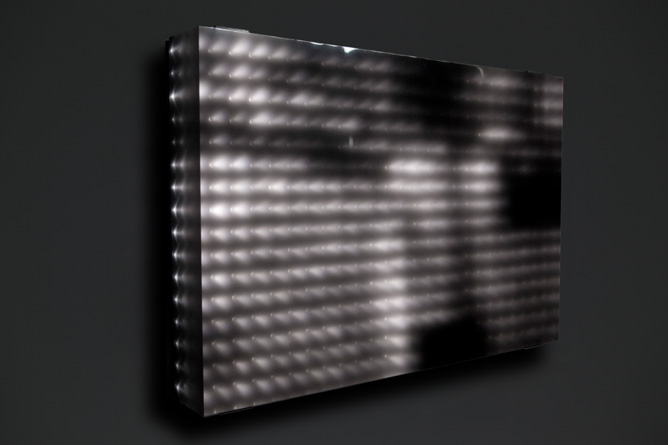
In this week’s reading from New Philosophy and New Media (2006), Mark B.N. Hansen lays out the foundations for his theory of new media art, rooted in a phenomenological, Bergsonian understanding of the way artists and audiences engage with such data. The work of photographer, digital video, new media and installation artist Jim Campbell engages and illustrates many of Hansen’s ideas regarding embodied vision, and its role in framing the flow of digital flow of data for every viewer, in his current exhibition Exploded View (through May 22, 2010) at Bryce Wolkowitz Gallery. Arguing for the radical newness of new media art in the face of dismissive evaluations like those of Rosalind Krauss and Liev Manovich, Hansen writes, “with the flexibility brought about by digitization, there occurs a displacement of the framing function of medial interfaces back onto the body from which they themselves originally sprang” (22, emphasis original). For Hansen, the content of a new media artwork, transformed into raw binary data, is increasingly liberated from the material requirements of one particular medium or support like a canvas or photographic print. Consequently, the body takes on the role of delimiting the scope and scale of the work’s data or, as Hansen writes, “as media lose their material specificity, the body takes on a more prominent function as the selective processor of information” (22).


In Campbell’s work, particularly the titular centerpiece of his new exhibition, the information on display makes viewers irrevocably aware of their role in framing and processing of the piece. Furthermore, “Exploded View”undermines the incompatibility that Hansen posits between his interpretation of Bergson and Deleuze’s willingness to grant a certain autonomy to the support through which artworks are presented to viewers (8). Campbell’s practice involves the juxtaposition of moving and static images, the presentation of digital video footage in forms and framing devices that challenge our ability to perceive any figurative data at all, and a foregrounding of the comparatively simple pixel and LED units that make up these visually complex works. In many pieces, such as “Montgomery Street Pause” (2010), the work seen from a distance shows a horizontal, cinematic street scene in black and white made up of over a thousand LED lights under plexiglass playing in a loop that pauses at its midway point. Upon closer inspection or from an askew angle, however, the figurative image disappears and becomes a fluctuating, abstract pattern of miniscule individual lights of varying intensity. The piece suggests one way we might view its data, while allowing for the body “to deploy its sensorimotor power to create the unpredictable, the new”(7).


“Exploded View”(2010) maximizes the role of viewers’ bodies. From one very specific position, the strings of LED bulbs hanging in the darkened gallery like holiday garlands coalesce to reveal endlessly looping footage of a silhouette walking in a circle, falling, getting up, walking further, falling, getting back up and so on. There is no suggestion that this is the one, “correct”way to view the piece: viewers move around the work freely, apprehending it as an abstract flow of lights not unlike rainfall from certain angles, a kind of digital interpretation of a drip painting in four dimensions. The piece, as Hansen writes, “introduces the power of creativity into the sensorimotor body”(8) just as it asserts the autonomy of this very specific material presentation of this particular video loop; namely the custom LED structure that Campbell, an MIT-trained electrical engineer and mathematician, designed for the piece. Like the figure in the video it displays from that one specific angle, we circle “Exploded View”encourages us to move around it, apprehending it from different angles and distances. If occasionally we fall into the one spot from which we see the figure running and falling, Campbell’s light and video installation encourages us to keep moving. In doing so, “Exploded View”problematizes Hansen’s opposition between the frame and embodied perception (8). The piece, like so many of Campbell’s works, foregrounds the process by which “the image becomes a merely contingent configuration of numerical values” (9), and in this particular configuration as pixels displayed with LED lights it frames one specific form this data can take, while empowering viewers to frame it differently. It frames a digital image that then “explodes the frame” (35). Rather than suggesting a limitation of Hansen’s work, this additional wrinkle in his new media theory demonstrates the rich complexity of emerging contemporary art practices such as Campbell’s.


This is a video of an earlier piece by Jim Campbell, "White Circle" (2000), which shows how his works go from figurative to abstract based on the angle and proximity of the viewer.


-Benjamin Sutton

Wednesday, March 24, 2010

An Ocean of Animate Forms

Greg Lynn’s Blob and Mary Mattingly’s Waterpod


In the first chapter of his book Animate Form (1999), Greg Lynn outlines formal properties of virtual architectural, aesthetic and scientific practices that take into account contextual and environmental factors using, among many other analogies, the very helpful and illustrative metaphor of a boat’s hull on the water. Lynn’s outline calls for a very radical and far-reaching (and Deleuzian) move away from the Cartesian habit of imagining that creations like artworks, performances, buildings and architectural models are created in a vacuum free of determining forces other than our own. Rather, such works should be conceived, designed and carried out in anticipation of the ever-shifting context in which they will invariably exist. He calls for a “shift from a passive space of static coordinates to an active space of interactions [that] implies a move from autonomous purity to contextual specificity” (11). With its development of, and frequent returns to the aforementioned nautical metaphor, Lynn’s argument anticipates the ongoing Waterpod Project conceived, developed and overseen by photographer, designer and environmental artist Mary Mattingly, which, it seems to me, explores and activates many of the suggestions Lynn makes regarding how artistic and architectural practice ought to evolve.


Though it has been built – indeed, an exhibition documenting its maiden voyage in the summer of 2009 is currently on view at the Midtown Manhattan gallery Exit Art – Mattingly’s Waterpod began as an architectural model created using computer rendering software to, as Lynn writes, “develop a systematic human intuition about the connective medium” (20). Using this technology, Mattingly created a digital plan for a boat that could support a self-sustaining community while traveling over another self-sustaining system, or an “architecture [that is] modeled as a participant immersed within dynamical flows” (11). The Waterpod, then, is not only a relatively static space where artists can create, exchange ideas and present their works, but a living architecture designed to be a traveling community of artists who can collect rainwater and solar energy, and grow their own food while being in constant movement over a surface that couldn’t be construed as static even on the calmest of days. Mattingly’s water bound ecosystem – a fusion of sorts of the post-apocalyptic floating communities of the spectacular blockbuster flop Waterworld (1995) and Captain Nemo’s tyrannical underwater utopia aboard the Nautilus in Jules Verne’s 20,000 Leagues Under the Sea (1869) – achieves a sustainable stability by “embrac[ing] a sensibility of micro and macro contextual specificity as a logic that can not be idealized in an abstract space of fixed coordinates” (15). The micro-context aboard the Waterpod is the set needs of its inhabitants, a community of artists and activists whose vessel is also built to respond and adapt to the changing conditions of the macro-context (oceans, seas, rivers, lakes, etc.) that it is designed to navigate. By making literal many of Lynn’s very ambitious suggestions for the future development of architectural and artistic practice, Mattingly’s Waterpod project represents a rigorous test of those theories, offers insights into their potential applications, and suggest ways in which animate forms have evolved in the decade since Lynn’s writing.


-Ben Sutton

Here's a short tour of the Waterpod from Rocketboom:


Wednesday, February 24, 2010

A Reappraisal of Relational Aesthetics

In Relational Aesthetics, Nicolas Bourriaud outlines a theory of contemporary art, paying particular attention to the ways that present-day artists break with the traditions of Modernism, or perhaps more accurately, adopt, shift, distort and transform the goals and ideas of modern art. As Bourriaud writes, “Social utopias have given way to everyday micro-utopias and imitative strategies, any stance that is ‘directly’ critical of society is futile, if based on the illusion of a marginality that is nowadays impossible if not to say regressive” (31). Thus, art proceeds within the world of lived relationships and circumstances, creating new conditions –what he calls “relational devices” – out of the set of existing forms, objects and relations. It does this by taking up and transforming existing conditions and relations, such as those that persist in the art world: “The exploration of relations existing between, for instance, the artist and his/her gallery owner may determine forms and a project” (33). In such projects the art object, however immaterial it may be, now becomes “a relationship with the world rendered concrete by an object” (48).


In her two exhibitions “The Appraisal” at Steffany Martz Gallery and “The Reappraisal” (pictured above) at Winkleman Gallery, the first in 1999 and the second in 2009, artist and former Christie’s auction house employee Jennifer Dalton auctioned off objects from her home. In “The Appraisal” she had the possessions in her apartment valued by Christies and then sold some of them on Ebay, comparing the estimates from the former to the money obtained via the latter. Some of these works were her own paintings and sculptures, or those of friends, but the auction also included found furniture and household belongings.

In “The Reappraisal”, she made an inventory of every item in her home on index cards with photos, descriptions and initial bids based on their emotional value to Dalton, her husband and their four-year-old son. For the five weeks that the exhibition lasted – the materials in the gallery consisting of shelves full of multicolored index cards – visitors could bid on any and every object from Dalton’s home. Here, Dalton collapses not only the utilitarian value of an object and its aesthetic qualities – a manipulation at work in the readymade artworks of Marcel Duchamp – but she adds the additional economic wrinkle of translating emotional attachment into economic terms. In so doing she underlines the fundamental equality between the objects in her private home and those shown in an art gallery. As Bourriaud might write, both classes of objects are valuable as material records of immaterial relations between people, whether they be Dalton and her family and friends, or the gallery-goers who appraise and, in some cases, buy her belongings.

Dalton's installations and performances address some of the questions that were raised in our conversations in class tonight, about whether or not such events, situations and relations have some inherent value (whether we call it democracy or discussion, or something else), or if they need to be qualified by some additional criteria like those suggested in Claire Bishop's constructive criticisms of Bourriaud's work. Being in an art gallery certainly limited Dalton's audience: even though admission to the space is free there are certain cultural boundaries implicit in the gallery space, certain inherent values to the way art is presented that allow some people in and not others. That being said, Dalton's work also acknowledged its status as art that has the benefit of certain privileges based on differences of class, race, sexuality and gender. The work she presented, the life being appraised, was very clearly that of a middle-class white woman living in a suburban home with a husband and child. In making these cultural circumstances apparent, Dalton's "Reappraisal" at least acknowledged and addressed the problems of homogeneous spectatorship that Bourriaud's work tends to ignore, even if she didn't necessarily posit a solution to those issues – as if one existed!

Below is a more or less helpful video of the installation, with commentary that isn't always valuable but provides good context. There are also more images of Dalton's exhibition here.

- Ben Sutton