Showing posts with label Cinema. Show all posts

Sunday, May 23, 2010

The City as a Milieu for the Virtual to Happen, Part Two: Any-Space-Whatever


According to Deleuze, in classical cinema space is continuous in such a way that it supports the characters' actions. Therefore, time is imprisoned in the continuity of the story and that is why classical cinema works as a closed representational circuit in a similar way to how the represented city is closed to creative experience. Only with the emergence of the modern cinema does the status of cinematic space change: "purely optical or sound situations become established in what we might call 'any-space-whatever,' whether disconnected or emptied" (Deleuze, p. 5). In other words, the space in modern film does not stand for the continuation of the predictable film narrative; rather it stands for temporal subjectivity and, at the same time, the objectivity of the ambiguous real. In my opinion, the creative and non-representational relations with the city are grounded in the same idea of attentiveness to the virtual and the unknown. The creative openness, without any effort to subtract only what is needed (for purposes of utility), helps us come closer to a non-representational complex image of the city.

These thoughts inspire me to work on my project "Any-Space-Whatever," which is supposed to be the second part of the installation "Cinematic Journey Through Time." "Any-Space-Whatever" is a cinematic urban exploration that aims to reconsider the representational image of the city as well as to examine the exceptional temporal dimension of the cinematic medium. During the production part of the project a number of HD video studies in abandoned places all around New York City were shot. They will be screened on the four walls of a black box installation space.

The project examines the temporal dimension of cinema and the city at a few different levels, as presented below. First, the places chosen for cinematic explorations are not-yet striated spaces because they do not belong to the trajectories of everyday life and do not, in the words of Guy Debord, exist for purposes of consumption. Therefore, the first temporal aspect of the project is based on an unpredictable personal encounter with places without knowing in advance what will be found. To put it briefly, the cinematographic studies were implemented in time.


Second, according to Deleuze and Guattari, smooth space (which represents temporal becoming) does not mean homogenous space, quite the contrary: it is an amorphous, non-formal space. In this connection, abandoned, wasted, post-industrial places I have visited so far do not have a stable identity; rather, they are in a transitional mode between their striated past, which is already over, and a future identity that is still unknown. The buildings are fragmented, full of holes and gaps; walls are not vertical anymore, windows are leaky. The places are dehumanized and only serve as homes for silent wind, forgotten memories and unrecognizable relics. Therefore, the second temporal aspect of the project is decided by the space's transitional position in time. All the places I have recorded are in constant change from the striated to the smooth, having the impressive traces of both periods. As Deleuze and Guattari write, "a smooth space emanated, sprang from a striated space, but not without a correlation between the two, a recapitulation of one in the other, a furtherance of one through the other." So, I would say, that records of the abandoned places are portraits of duration of their temporal smoothness.
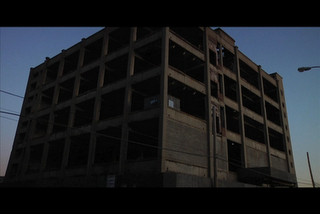
Third, the cinematic techniques I have chosen to use for capturing the temporal existence of these places formulate another temporal component of this project. 360ยบ panning long takes and static shots edited together with the sounds partially recorded on location move the short cinematic studies closer to the real time of the recorded places rather than the manipulative construction of personal and conventional views on the part of the cinematographer. Spontaneous editing was used only for the purpose of assembling the details together into the larger whole but not with the intention of stimulating a third meaning between the shots (ala Eisenstein). In my opinion, details from each location could be easily edited in various ways without paying attention to narrative at all. These places, following Deleuze, could be called "dehumanized landscapes of emptied spaces having absorbed characters and actions, retaining only a geographical description, an abstract inventory of them" (Deleuze p. 9).


Finally, in the end of the cinematographic study, the time-image is freeze-framed and combined with an artificial clock sound in order to inspire the viewer to rethink the relation between the real durational time of these spaces and constructed or abstract time. Summarizing the project, I would hope it could help us to reconsider the temporal, non-representational dimension of cinematic practice as well as re-think the representational image of the city.

Lukas

Tarkovsky Example of Plot Movement Becoming Time


If you've read some of my other posts you know that I've been doing some research on the potential for the movement-images described by Deleuze in Cinema 1 to become time-images within respective shots and montages. I believe one example in film that accomplishes this blend is the pool sequence which occurs towards the end of Andrei Tarkovsky’s Stalker. In one shot we get sustained voiceover (which actually begins in a previous shot) while the camera slowly moves from a close-up of the main character to a tracking shot peering straight down over a shallow pool. The voice over eventually fazes out and we hear a symphonic blend of eastern meditative music fade in as the shot eventually ends with the camera making its way back to an inanimate hand half-submerged in the pool. Through this shot we are partially made privy to the true nature of “The Zone”, which is what the characters in the film (and the audience) are eager to uncover.

Here's a clip of the sequence (shot starts at :57):
http://www.youtube.com/watch?v=OfowVslQBQk&feature=related

By combining this narrative reveal with the superbly executed long take and flow of visuals, music, sounds, and dialogue, Tarkovsky achieves that ebb and flow of action-oriented plot, pure contemplation and reflection, but also formless movement through the motif of the water. In examples like this it is more of a challenge to connect action and perception with time and sensation because the two extremes naturally remove one from the other. By condensing these opposing forces into small sequences/shots a filmmaker can really induce powerful affects in the viewer.

--Jonathan Masino

Long Take Experiment Two (Movement Becoming Time)

http://vimeo.com/11953460
Password is deleuze

Here is the full video of what I showed in class regarding my project attempting to depict examples of movement-images becoming time-images and vise versa. This particular experiment is a collection of 9 frames arranged next to each other in a grid. Six of the frames I chose are examples of classical movement-images that are related not only to mobility, but also to modern transportation. I wanted to use the earliest known infatuations with movement such as distinct POV shots that embodied movement of character. In these types of shots the sense of movement is easily achieved through the changing scenery as it relates to the mobile unit; however, it can also be accomplished by showing a mobile object approaching the stationary viewer as is the case in the classical example of a distant train gradually approaching a station. These would be considered forms of perception-image, which is a subset of the movement-image.

Two of the other frames I utilized are images of household chores: a laundry machine and a sink of dirty dishes being washed. While these aren’t conventional action-images they do create a feeling of movement in the sense that the viewer/character is moving towards the completion of something (i.e. the finished load of laundry and the clean sink respectively). The final frame I used is the one most closely resembling a time-image. It begins with a close-up of leaves on a tree blowing in the wind and gradually zooms out to reveal a larger environment. Later on in the shot we see a character walk through the space where we get a sense of body as it relates to environment (a-la Antonioni), which again is a form of perception-image.

With this collection of movement-image frames I tried to morph them into one whole time-image. The key for me was to transpose the affection of the images into a cumulative experience. With the movement-images we are more concerned with perception, specifically optical perception, while with the time-image we are more concerned with sensation; a more tactile and visceral response from the viewer that evokes a feeling of time and duration.

As the piece develops and we introduce more frames I think the collection of familiar images creates a “new” image when viewed together as one. By doing this we do indeed take the movement-images of everyday perception (which we can relate to the narrative of our daily lives) and mold it into a future image (or the potential and the virtual) that allows the audience to construct some sort of meaning from them (which can be a more poetic interpretation of our routine existence).

Despite some success there were several problems with this experiment. To begin, the captured sounds required an investment of more time in the mastering of the sound to artificially smooth out the soundscape. The main problem was that some of the sounds stood out more than others and even though their audio levels were lowered accordingly, they still managed to pierce through the collective orchestra of clicking and clanging by nature of their unique timbre and high familiarity (the subway sounds were difficult to assimilate). The experiment also required more diverse environments/sounds. I think I overly used cars and trains in the different frames. I should’ve thought about using footage of boats, planes, and bicycles to provide more variation in the images.

In addition, this juxtaposition of movement-images would’ve been more successful had they been in context of a greater whole or narrative. If all the frames depicted a group a characters en route to rendezvous somewhere, I think this collection of images would’ve successfully taken the audience from an image of a sensory-motor schema to an image of pure optical and sonic sensation that lends itself to reflection and contemplation, which would’ve take the audience from an action-image to a time-image.

--Jonathan Masino

Long Take Experiment One (Character Becoming Viewer)

http://vimeo.com/11952416
Password is deleuze

This is an example of one of the long take experiments I conducted for my project suggesting the interchangeability between action-image and time-image in a filmic setting. In this example I attempted to achieve this feat by seamlessly altering the audience's perspective from a vicarious viewer (through the eyes of the onscreen character) to an independent viewer. Deleuze mentions in Cinema 2 that in the time-image "the character within the film becomes a viewer".(1) This long take attempted to emphasize the vacillating perceptions/contemplations between both the viewer and the character (acting as both viewer and non-viewer). The main idea was to morph this continuous shot from a time-image (e.g. disjointed images, a contemplative character/viewer, etc.) to an action-image (e.g. the character reacting to a noise, eye line matches, etc.).

I think this particular experiment accomplishes the movement from POV perception to character perception within the space affectively. We get that sensation when the camera moves from the close-up of the book to a close-up of the character’s face looking off in the distance, which is then followed by a slow motion pan to scenery that is out of focus. I was trying to move from a action-image that directly reflects the perception of the character to a time-image where we see the character perceiving the space and also contemplating. The movement back to a quasi-POV by way of the pan was designed to visually display the change of perception as a result of the contemplative character. When our minds are meandering (or in a smooth state) we are less perceptive to detail; hence, the images become out of focus (both literally and figuratively in this case).

I think we also get a good sense of action-image becoming time-image when the character’s reading session is suddenly interrupted by the off screen noise of a car skidding. This aural disturbance triggers an action in the character that demands a different viewing experience from the viewer. Furthermore, the noise is sandwiched between two moments of reflection as the character views text and images evoking nature, while at the same time experiencing nature firsthand through time, duration, and perception.

--Jonathan Masino

(1) Deleuze, Gilles Cinema 2 p.3

Saturday, May 22, 2010

Contemporary Independent Filmmaking

Ever since my time as an undergraduate film student, I have struggled with the idea of independent filmmaking and the state of contemporary independent films. The current state of indie films came to mind again while working on my final paper, which focused on the work John Cassavetes. His status as the pioneer of American independent filmmaking still resonates with filmmakers today.

It seems as though indie filmmaking has become an aesthetic style more so than a way of creating a film. During my presentation, Sam mentioned the cinematography of indie films. The use of the hand held camera has become the ubiquitous amongst indie films these days. This was used for very specific reasons by previous influential indie filmmakers, but it should not characterize a film as independent. Although indies lack major studio funding, they often have the advantage of more creative freedom. This does not only apply to the overall content of the film, but for the crew as well. I often found on professional sets that the people who had a background in film had the most difficult time adjusting to a lack of creativity on set. However, there are instances in which, even as an intern, I was given some creativity freedom on an indie film. These creative allowances were rarely given to anyone except heads of department on studio films.

Although there is more creative freedom, there also seems to be a pre-packaged style that has developed even for indie films. I cannot completely disregard film school since I attended one, but it is obvious that film schools have a tendency to instill a pre-packaged concept of the “perfect” film in its students. This applies to both studio and indie films. Indies have developed their own format for the “perfect” film over the years. However, this format often emulates that of earlier filmmakers without taking into account the best aesthetic choices for each specific film. Just because you are an indie filmmaker, does not mean that you have to make a serious art house film with your friend’s digital camera.

I am interested to see how the future of independent filmmaking evolves in years to come. In recent years, there seems to be an emergence of interest in indie films again thanks to events such as the Sundance Film Festival. Indie films have taken on an aura of being “hip” and “artsy.” Hollywood certainly did not fail to notice this trend in the popularity of indies. Currently, indie filmmakers have more possibilities for having their films seen than ever before. The internet has provided a perfect platform to showcase their work. The plight of the indie filmmaker is as relevant today as it was in the previous decades, except for the ability to have a film seen more easily due to technological advancements. Jonas Mekas created The New American Cinema Group and subsequently the Filmmakers’ Cooperative, which still distributes films today, to help aid the underground filmmakers in the production and distribution of their films during the 1960s (the manifesto for The New American Cinema Group can be found here, and is definitely worth reading). Thanks to the advent of digital film equipment and the internet, filmmakers do not have to rely as heavily on the help of others to have their films seen and distributed, and they may not have to spend money on film stock or processing fees.

Obviously there have been a lot of generalizations made here, and my thoughts are merely my constantly evolving opinions on the subject. Many of these opinions do not apply to every indie film, of course. I think that overall my issue with indie films is that they have taken on an aesthetic style that is not always necessary or relevant for each film. They often try to emulate the stylistic choices of previous independent directors, thus somewhat disregarding the greatness the indie film’s ability to have more creative freedom than studio films.

- Stephanie Class

Crisis of the Historical-Image

One of the things that struck me in Andrei Tarkovsky's book Sculpting In Time, was his theories on films embedded in specific time periods. He spends a small section of the essay talking about the challenges his crew faced when filming Andrei Rublyov, which takes place in the fifteenth century. He makes the bold claim that by focusing too much on "how everything was" the filmmaker actually does the cinema a disservice [1]. In virtually every big production period piece we see today, the primary emphasis is put on historical accuracy: Do the costumes match the period? Are the actor's speaking in correct accents? Do the props and the scenery evoke the proper time? These obsessions with period and detail only detract from the emotion, the rhythm, and the character of the film. Asking these questions will only kill time, which Tarkovsky tries so hard to sustain. The image becomes completely historical, but for Tarkovsky, history is not time; it is only a consequence of it [2].

Tarkovsky would probably argue that when making a period piece, the filmmaker should be emphasizing the likeness between the film and the viewer instead of the difference. This would be the only way to enable the audience to endure time through the cinema. By magnifying the minute details of the period, the cinema becomes more of a museum hall than a proper theater. The material is instantly frozen in time and made into a relic, inaccessible by the audience. The viewer is distanced from anything the filmmaker might be trying to convey.

In Andrei Rublyov, while the art direction is appropriate for the times, it isn't beaten over the viewer's head. The audience is able to experience the characters more closely and the long takes become more contemplative and visceral as opposed to simply visual. I'm actually trying to achieve the same thing in my graduate film, which takes place in an unspecified time and place circa war torn Europe in the early twentieth century. I was undaunted by the difficulty in shooting a period piece on a low student budget, because of the notion that I could establish a better sense of time without emphasizing the era, but how I believe that time was experienced by the characters. Just because a film is made in a classical period does not mean it must be made classically; one can make full use of the more modern time-image, which Deleuze speaks of. As he also states, the time-image creates a sense of present/pastness. The films that focus on capturing historically accurate details are only considering the past, and are not merging it with the present viewing, which is necessary for the time-image. This historical-image is fully crystallized in that it has already achieved everything it can; there is no more virtual and there is no more connection to the body. The historical-image has become all it can before it is even viewed by an audience. The affect for the viewer would only be one of an academic appreciation at best, but not new though process would be generated. With the time-image, the image is still alive and can continue to become.

(1) Tarkovsky, Andrei Sculpting in Time, p.78
(2) Tarkovsky, Andrei Sculpting in Time, p.57

--Jonathan Masino

Friday, May 21, 2010

A Woman Under the Influence

When writing on Deleuze and Cassavetes, I wanted to examine how Cassavetes was able to take Deleuze’s modern elements of cinema and create a highly affective film. Cassavetes has the ability to draw emotional responses from his viewers, and I used Deleuze’s writings to better understand the way in which he is able to accomplish this in his films. The following is a scene that I consider to be a solid representation of Cassavetes’ directing style. In this scene, Mabel is confronted by her husband, Nick, about her deteriorating mental state. Nick’s mother and Dr. Zepp are called to the house to help regulate the situation and enforce her institutionalization. I have a love-hate relationship with this scene each time I view it. I find it unsettling and difficult to endure because of the intensity of the acting and the subject matter. However, I don’t want to look away from the action either. This scene also exemplifies the way in which Cassavetes would force the audience to fully experience an entire situation with the actors on screen. He lingers in the scene and refused to make any unnecessary edits. According to Cassavetes, experiencing the entirety of the scene was imperative the structure of the film. “You can’t edit the film any more than you can direct the film. You’re not able to make the film play any better than it plays…Take the scene of Mabel’s breakdown, for example. We had to prolong it. The sequence was full because unless you actually see them do that, unless you actually see the continuity of that, the actual idea that he would do this and carry it through could have been weakened.” Also, it is easy to detect Cassavetes’ stance on the use of cinematography. The DP was told to follow the action he felt was important in that moment, instead of having distinct set-ups for each shot. Overall, this scene exemplifies many elements of Deleuze’s concepts of modern cinema, along with the emergence of thought and the mental-image in film.

Here are the links to the majority of Mabel's breakdown scene (my apologies for having to navigate away from the page, but uploading was not possible due to the size of the two clips):

http://www.youtube.com/watch?v=1zPVpRGlPbo
http://www.youtube.com/watch?v=cgUf4VBaRjo

- Stephanie Class

Notes on a Filmosopher

From Ridley Scott, director of Gladiator (2000), comes Robin Hood. The trailer for that popular film type informs audiences that watching an epic story will be like watching the other. Thus, they will have some expectations about Robin Hood because they presumably have watched the former film. Trailers are not necessarily shown in movie theaters: they proliferate online and on TV. Thus, Daniel Frampton’s idea a film is “an organic intelligence…a ‘film being’ thinking about the characters and subjects in the film” suggests that audiences encounter films without any notion of what it is or where it came from (7). I agree with Frampton that film induces some kind of a waking dream state, where we forget about directors, Hollywood, and camera angles to experience the film as a new world. However, we are not innocent to filminds or film worlds, especially if we are anticipating moments in some film worlds, as if we have travelogues prepared/habituated thanks to the domination of narrative.

Frampton states that film offers philosophy, rather than validating philosophical concepts. I see no problem in philosophers using film for philosophical discourse. Films can reveal the intricacies of debates like cloning and the sanctity of identity, or the instability of judicial meaning in particular legal situations. Besides, some narratives express philosophical issues by their very construction: story and character. If academic writing takes the position of philosophy offering its services to film, then it is the filmind that does this in its form of thinking.

Frampton also implies a general definition for or identification of cinema. An aspect of the filmind is “the creation of the basic film-world of recognisable people and objects” (6). Thus, as long as representations of reality are perceived, then the filmind is a legitimate being. Otherwise, nonrepresentational images have no existence. Since this concept is intended for the moviegoer, then he or she will accept narrative films as cinema. Abstract films do not any “film-thinking,” for there is no designing and figuring of the film-world. If films are to be treated as autonomous beings, then experimental/abstract films should garner the equality that standardized films have, in their recognition as filminds.

By Raul Garcia

Work Cited
Frampton, Daniel. Filmosophy. London: Wallflower Press, 2006.

Wednesday, May 19, 2010

Time Image Striation

My final project is going to be a series of long take video experiments that attempt to evoke the link between action image and time image as well as suggesting their interchangeability. In Gilles Deleuze’s two books on cinema (Cinema 1 and Cinema 2) he talks about the evolution of the film medium by nature of its frames and especially of the images it produces. In Cinema 1 Deleuze describes the images of the classical era as action images. That is to say that they are predicated by cause and effect. Every shot, every movement, every piece of dialogue is motivated in some way, shape or form. The characters in these classical films were always active, never passive. There is always a goal for the protagonist to aspire to and there is always an obstacle that must be overcome. These images remain constant in film until the aftermath of World War II where we see an emergence of a new kind of image. This time image, as Deleuze refers to it as, represents the movement towards modern cinema where characters are reflective instead of active. We see them observe through the frame and as a consequence, the audience thinks and perceives with the character.

I would liken the time-image described in Cinema 2, as a manifestation of another Deleuzian concept, smooth space, which Deleuze discusses in detail along with collaborator, Felix Guattari, in A Thousand Plateaus. For Delueze, smooth space is defined by its unlimited variation and its vast realm of possibility. In the time-image, the viewer and the character(s) are both in an ineffable space absent of any provocation. According to Deleuze, we become a new breed of character in this space because we are contemplative and unsure in lieu of being reactive and physically or emotionally active. This a-centered mental capacity brings the viewer and the character into a state of smoothness where the trajectory of our perception is boundless and our tactile acuity is heightened. Our collective minds become a smooth nomad wandering from thought to thought with no anticipated direction in sight.

On the contrary, the action-image would be of the same ilk as striated space. The formulaic structure of action-oriented plots and movement changes at pre-defined junctures is a form of striation that regulates the delivery and construction of cinema. The viewer was to be ensconced in the narrative so that any other elements of the filmmaking apparatus (i.e. music, soundtrack, camera movement, etc.) were only to be used to enhance the narrative and if they couldn't, they were to be downplayed so as to go unnoticed by the viewer (e.g. cuts in the middle of actions).

So if we can come to the conclusion that the action-image is a form a striation and the time-image a form of smoothness, then we should also be lead to the conclusion that the time-image and the action-image can become each other and reach a point of interchangeability just as it is so for smooth and striated space (e.g. the naturally smooth dessert being segmented and striated by mapmakers) as Deleuze asserts. For Deleuze, neither smooth nor the striated spaces are permanent and impervious to change and becoming. Once again, the goal of my project is to display this interchangeability and constant evolution between the action-image and time-image relationship through the film media itself. This will be done through a series of long take experimental shots that look to alter perception from the haptic to the optic within the same continuous shot. I hope to achieve an affection that is not static, but continuously emerging. Although I’m sure (in true Deleuze fashion) the process of developing these short projects will reveal even more ideas about morphing viewing experience within shots, which can be further explored in future endeavors.

--Jonathan Masino

Tuesday, May 18, 2010

Why Do People Go to the Cinema?

Earlier in the semester we discussed Tarkovsky’s writings on the cinema in a chapter from his book, Sculpting in Time. The chapter "Imprinted Time" contained a myriad of intriguing concepts regarding the cinema in general. It was his discussion of the cinema experience that I found to be most interesting. Tarkovsky boldly asks, “Why do people go to the cinema?” He briefly examines the way in which, despite the commercialism and entertainment aspects of cinema, a person goes to the cinema to experience time:
He goes there for living experience; for cinema, like no other art, widens, enhances and concentrates a person’s experience – and not only enhances it but makes it longer, which have to do with the human need to master and know the world. I think that what a significantly longer. That is the power of the cinema: ‘stars,’ story-lines, and entertainment have nothing to do with it [i]
Tarkovsky successfully outlines the reasons why a person looks toward the cinema to experience life. Of course, there are people that depend on the cinema for entertainment too, but there are many more that go to the cinema to learn about life and learn about themselves in the process. I’ve always looked to the cinema as a therapeutic place, an educational place, and sometimes a place to be disturbed or shocked. It is a place to go and figure out yourself a little more through the images presented to you. I feel as though Tarkovsky’s description perfectly explains some of the reasons why I find the cinema to be amazing, interesting, and undoubtedly important to the art world.

However, is this experience negatively effected when the movie theater is taken out of the equation? Although Tarkovsky obviously wrote about cinema before the advent of certain new media and technology, which brought new formats to the film viewing experience, it is relevant to cinema today. Going to an actual movie theater is no longer necessary to view a film. It begs the question, are we losing an important aspect of the cinema by losing the movie theater experience? Personally, a movie theater will always be the optimum choice for viewing a movie. The theater separates the audience from outside distractions, thus allowing for a complete encounter with the piece. At home, the viewing experience is riddled with distractions and interruptions. A viewer can stop and start the movie at any point, work on other things while watching, or even skip through parts completely. Seeing a film in a theater creates a vastly different experience for the viewers than when it is seen in the privacy of their own homes.

Hollywood and capitalism have always been linked to one another. It is difficult not to look at that decline of the movie theater experience as a result of capitalistic ventures. However, one also must not completely put blame on capitalism for these issues. A movie ticket generally costs around $12.50 today. As much as I would always prefer to go to a theater, it isn’t always the most financially sound decision to makes. I can rent movies On-Demand for 24 or 48 hours for $4.99 or less. I can see more movies for the price I would be paying to go to a theater. Also, there are the online renting options, such as Netflix, which allow us to pay a monthly fee that is often times cheaper than one single movie ticket. Overall, the theaters aren’t giving the casual viewer much motivation to go to their venues.

It will be interesting to see how the new media outlets influence the production of film overall. Amateur filmmakers can easily have their work seen thanks to digital technology, which is certainly a positive aspect of the expansion of the cinema. However, many major filmmakers now must take into consideration how their film will be perceived on smaller formats (computers, home television screens, I-pods, etc.). A movie no longer must be viewed on a projected screen, thus possibly changing many of the aesthetic elements of the work.

Overall, the content remains the same no matter where a film is viewed. It is the audience’s response that can be influenced according to venue. The theater allows us to be completely immersed in the images and stories being projected for us. At home, we can allow our own lives to take precedence over the viewing experience. The actual film has not change, but our reading of it has altered according to the attention we give to it.

- Stephanie Class

[i] Tarkovsky, Andrei. Sculpting in Time. (Austin: University of Texas Press. 1989), 63.


Sunday, May 9, 2010

Film Shoot

Last week I worked on a film shoot that documented a person’s entire day – from 5 AM on Thursday morning until 5 AM on Friday morning. The shoot took place during the subject and filmmaker’s birthday. The idea came from James Joyce’s Ulysses, in which every chapter is a new hour of the day, and so for every hour we had a new cinematographer come and film him. The same thing was happening with his wife and son, so we had at least three cameras going at all times.

I was in charge of making sure that the handoff of shooters happened smoothly. We tried to make the transition as smooth as possible. While Camera A was shooting the subject I would prep Camera B and give it to the next cinematographer. At the turn of the hour Camera B would shoot Camera A for one minute, at which point Camera A would turn to Camera B, Camera B would turn to the subject, and Camera A would be turned off.

Although we tried to make these transitions smooth, the time-based nature of it made the day full of striation. This was in part a technical necessity (batteries and SD cards cannot shoot for 24 hours), and also an artistic choice. Being the person who was in charge of these quick changes I became uncomfortably aware of the time. For a full day, every hour became an ordeal for me, an event. Sometimes these events were more stressful than others (did people show up on time, are we in the middle of the city, how many empty SDs cards do I have in my pocket right now), but they all happened with the same amount of time in between. I was affected when I finally tried to go to sleep by popping my head up on the hour, expecting to have to do something. My body had become used to the rhythm.

The inevitable outcome of the piece, was that it became a film about making a film, rather than an average day (which is what was expected). Of course, the subject is a filmmaker, so the nature of the day is not entirely unusual. One thing that I really noticed about the piece was how it brought together a community. With 45 shooters come in and out over the course of the day -- all of whom were somehow connected to the filmmaker, and most of whom were artists – I watched the world that surrounded him meld together. Many of the shooters would have three shifts (one on each subject) with an hour break in between each one, so they would be around for 5+ hours. People would hang out at the house on break, and stay late, as a community of artists gathered. I found the scene very inspiring.

One of my moments of the day was when all three subjects (as well as their three shooters) were in the backyard. Mom and Dad followed closely as their 14-month-old son ran around the yard. Once the shooters had their angles they stayed close as well. So the outcome was 6 people moving in unison, all moving in rhythm as a cohesive unit, as a toddler led the way kicking a ball as he went.

-- Jake

Monday, May 3, 2010

Deleuze and (Modern) Political Cinema: “The People are Missing”


In chapter eight of Cinema 2, Deleuze discusses what he calls “minor cinema,” and in the context of the modern political cinema of such filmmakers as Glauber Rocha, Ousmene Sembene, and Pierre Perrault (a Brazilian, an African, and a French Canadian, respectively). Political film of the classical period is premised on the idea that “the people are already there” (C2: 216): the people pre-exist their representation in film. In this cinema the filmmaker’s role is to bring to light, in a representative fashion, the concerns and struggles of the people. As Rodowick says (in Deleuze’s Time Machine, the first book-length study of Deleuze’s two volume work on cinema to appear in English and still probably the best one), the goal of political film in the classical period is “to represent the masses or ‘the people.’ They may be oppressed or in the process of liberation, alienated or awakened, but representation is nonetheless their right. That they are representable as a collective image, and that their political self-consciousness is also renderable in images, are givens” (1997: 152). All political films, documentary or otherwise, premised on the notion that the filmmaker is simply and objectively recording a reality to which he or she remains external or detached would be an instance of this kind of classical political cinema.

Modern political cinema begins from a very different position, premised not on the “already there” of the people but on their absence. In the words of the experimental Italian theatrical director Carmelo Bene, “the people are missing.” Bene says this in response to the query: for whom is your theatre addressed, to which people are they addressed? Bene’s answer: his work is addressed to a people who do not yet exist; a people who do not preexist their performative enunciation through, or with, the work of art. This, according to Deleuze, is also the answer found in modern political cinema. The stakes involved in proclaiming the people “missing” is nowhere more evident than in the postcolonial cinema of Rocha and Sembene. These filmmakers, Deleuze argues, understand that what is required is not simply an assertion of an identity counter to the one proposed in colonial rule; they thus resist the urge to evoke dubious notions of “origins” – a true identity, a unified peoples, prior to colonialist domination – and, instead, actively seek to forge a new collectivity, a people who belong not to the past, to history, but to the future: the people as future conditional. “This acknowledgement of a people who are missing is not a renunciation of political cinema,” Deleuze writes, “but on the contrary the new basis on which it is founded” (C2: 217). It is because the people are missing, rather than present, that there is a necessity for political art.

***

For me, Deleuze’s remarks on “minor cinema” remains the most interesting of all his discussions of the “minor” in art (far more convincing than the arguments about “minor literature” that Deleuze and Guattari ascribe to Kafka). I find compelling his commentary on Rocha and Sembene and, along these lines, if I had time, I could add a few examples of my own (including the work of the great heretical Italian Marxist filmmaker and provocateur Pier Paolo Pasolini). Having said this, I’ve never been entirely convinced by Deleuze’s critique here of the work of Sergei Eisenstein as an instance of classical political cinema (and which has been repeated rather thoughtlessly by various Deleuze scholars, including R. Bogue). Does Eisenstein really presume the existence of a revolutionary proletariat, or does he see it as his – and other artist’s – responsibility to provoke or stimulate this revolutionary form of consciousness through the work of art? In the Soviet Union of the 1920s, the revolution has already occurred – literally so – but what remains unknown is the nature of the future communist society: what will it look like and what role the people will play. It is to this future collective that Eisenstein pitches his works. What interest Eisenstein is the ability of cinematic montage to stimulate both affective and cognitive responses and it is the imbrication of these two modes of spectatorial activity that allows cinema not simply to entertain its audience but also to transform them.

In this sense, we can’t say that the revolutionary proletariat pre-exist the cinema; the revolutionary proletariat is a being-in-formation and the cinema is one of the mediums through which it comes into existence. For Eisenstein, this meant that cinema needed to be pure experimentation, a mode of non-representational art in which the cinematic “image” is produced by the spectator in their encounter with a series of shots whose meaning is relational, whose meaning results from the tension produced by individual shots placed in conflict or collision, and which the viewer must resolve for himself or herself. This kind of experimentation became anathema in Stalinist Russia and precisely because the central administration no longer wished to provoke an (unpredictable) becoming; instead the goal became the affirmation of an identity that is already formed and complacent and a “true” ideology that doesn’t require thinking or feeling, only obedience. (Is it any surprise that Socialist Realism took the exact same "form" as classical Hollywood films, with their stories centered on the heroic exploits of the protagonist and the editing as unobtrusive as possible, so as to facilitate the suture of spectator to narrative, spectator to representation. Thought is no longer mandatory. Thought becomes optional.)

***

Those interested in the topic of art and the political, as well as Deleuze’s notion of the “minor,” might take a look sometime at Nicholas Thoburn’s excellent book on the “minor politics” of Karl Marx entitled simply Deleuze, Marx and Politics. Thoburn argues that Marx doesn’t posit communism as the simple description of a predetermined, and fully worked out, perspective or methodology but rather “a process of continual engagement with the flows and constraints of the capitalist socius towards its overcoming” (2003: 3). If it takes Marx sixteen years to complete the endlessly-revised Capital, Thoburn says, it is precisely because he is sensitive to the mutations that capitalism undergoes in the second half of the nineteenth century and because he is aware that such a strategic, dynamic mode of critique must also characterize communist politics. Marx thus re-configures communism as an immanent political practice, one that continuously discovers, or creates, a line of flight through the networks of capitalist production. “Marx presents the Communist Party, then, not as a distinct and timeless organizational form, but as a mode of engagement that is immanent to the content of the proletarian-in-struggle, which in turn is immanent to the particular configurations of capital” (Thoburn 2003: 40). The "proletariat" thus no longer simply refers to a particular group of people but to a revolutionary potential – a virtual potential – that awaits its actualization in, and as, our future.

S I-G

Wednesday, April 28, 2010

24 City and the Time Image

This movie, directed by the Chinese director, Jia Zhangke, brought me clarity about what we have been talking about lately in our class. I believe that it has the formal attributes to be considered an example of modern cinema.

The use of the long shots and depth of field and the approach to a reality intertwining fiction and documentary are the two characteristics that I would like to highlight.

The long shot takes us to another time within time and to another space within space. From the credits scene to the opening scene to the last scene we are transported to the history of factory 420, to the history of the expectation in a modern Chinese society, to the history of the characters, to the history of China, to the history of image and to the history of cinema.

The power of the long shots puts the viewer in touch with the subject even if we lost track of what they are telling, it doesn’t matter. One has so much time to delight in the image, to find the beauty where there is no apparent beauty, that the words of the speakers became just texture, not words anymore. Furthermore it is possible to apprehend history in layers, first the layer of the history of the character, second the layer of the history that this character are in touch with, third the layer of the history of image.

The framing, use of long shots, long takes and depth of field in this film took me back in time to Citizen Kane. Most of the shots used windows, mirrors and the architectural structure to create the framing within the framing. The camera movement occurs only when is absolutely necessary Je Zhangke is capable of generate a film experience, “a moment of awareness”. I’m sure that I will forget the whole story but the images will remain. The same image becomes 1000 images as in Citizen Kane, the transparencies, the mirrors, the windows makes the viewer fly more that just see. I wonder is here is an explanation or a link to what Deleuze meant when he was talking about the crystal image.

The feeling of being face to face with the exceptional characters that he brings to the screen is exceptionally convey in the scene of two men looking at the camera until they laugh, they laugh and the viewer laugh at the same time. They are looking at us and we are looking at them, is a game. I felt that the director was laughing too, making fun of him self, criticizing his own proposal.

Other aspect that interested me was the blend of documentary and fiction, stressing the boundaries between these two genders, just as in Neorealism. He plays another mirror game with the actress Joan Chen whose nickname is Little Flower. She is playing the role of Gu Minhua in 24 city and in her story she talks about how the people in the factory used to tell her Little Flower because she was very similar to this actress. I believe that these games bring to scene the inherent question of reality in cinema.

Finally I will like to say, that with this film I understood the power of the time image as the generator of a unique and whole reality, just A reality not THE reality It does not matter if it is documentary or fiction. Some might complain that he is leaving behind “the moral contract” with the viewer but I believe that he is generating a new relation between him and his work and between his work and the viewer. He is bringing back the “aesthetic contract”.

Susana

Wednesday, April 21, 2010

A Minor Cinema

In Chapter 3, Imprinted Time, Tarkovsky explains how he sees "chonicle as the ultimate cinema; for [him] it is not a way of filming but a way of reconstructing, of recreating life." (p.65) What I wish to draw out here is the emphasis that he places on the "recreation of life." Cinema here is not a reproduction or a retelling of an event but it is in itself the creation of life (a new event). Perhaps though, I am reading too much into this statement and Tarkovsky is not advocating for the construction of new realities through cinema but instead for the creative construction of time passed/passing, of blocks of time (life re-arranged, life re-constructed, new life?).

I think what I would like to incorporate into this line of thinking about cinema is the idea of minor practices, as discussed by Deleuze and Guattari, and more specifically the notion of "becoming stranger." Not only "becoming stranger" in one's own language (as in their literary examples), but I am wondering if cinema, through the "appropriation of time" cannot act as a minor practice and enable a "becoming stranger" in ourselves and throughout our territory? Considering our "immanent becoming," as discussed by Deleuze and Guattari, it seems as though cinema might be an appropriate medium for not simply "capturing" time (because that would attempt to trace it and render it solid), but instead to map, through/with time, and become along with the territory. Like the map, the attempt would be to engage in "an experimentation in contact with the real."

Not knowing really how to conclude these thoughts, I should add that the ideas presented here are part of a larger project of mine that is trying to conceive of documenting (documentary practices) in relation to a constantly moving self/territory. How can a documentary film map instead of trace? How do you work with a shifting terrain? Can this be a minor practice?

Vanessa Meyer

Saturday, April 17, 2010

Warhol and the Art of Framing

Recently, we discussed framing in terms of architecture. Framing allows us to see the relationship between architecture and cinema because it allows for the spectator to reconnect with the world in new way. The early film work of Andy Warhol can give us an insight into the power that framing can have on a film.

The aesthetic qualities of Warhol’s early films are seemingly rudimentary. His films were created using static, unedited, one-take shots on black and white film stock with a 16mm Bolex. Warhol reverts back to the techniques of early cinema while others were taking a more modern aesthetic approach to their work. Bergson’s commentary on cinema would apply to much of Warhol’s work since its technicality would have been similar to that of the films of Bergson’s time. However, this is not to downplay the aesthetics of Warhol’s films. His stylistic choices are part of what bring intensity to his work. His films have a minimalist aesthetic, but the subject matter is undoubtedly modern.

Warhol frames his shots in order for the viewer to experience the subject in a new way. He often removes the subject from the world that typically surrounds it in order for the audience to have an unsuspecting encounter with it. This is clearly seen in Empire. Warhol has a shot consisting solely of the Empire State Building. We are used to seeing the building towering above other Manhattan buildings, which make up the whole of the skyline. By seeing the Empire State Building as a singular object instead of a part to a whole, a new relationship with the building is formed.


Warhol’s ability to frame objects in a way to showcase them solely can also be seen in the 500 “living portraits” he shot between 1964 and 1966 know as Screen Tests. The Screen Tests consist of three-minute static shots of individual people. These films were all shot at the Factory, and it is clear that what was happening off camera was often times more exciting than what was happening on camera. Warhol took people out of the world around them in the Factory, away from the whole, to create an entirely new view of that individual. He has the ability to frame shots in way that restricts the viewer from what the human eye would see if they were present at the scene. Ann Buchanan’s emotional response to stimuli off camera would not have been as powerful if we had been allowed insight into what was happening in the world around her. Instead, removing her from the whole and focusing solely on her expression is what makes her particular Screen Test intriguing.

.


Additionally,
Blow Job serves as a perfect example of how Warhol masters the art of framing. This thirty-five minute film consists of a close up of DeVeren Bookwalter as he supposedly receives a blow job from someone off camera. Whether Bookwalter is actually receiving a blow job or not is left for the viewer to decide. Warhol allows the audience to have just enough information to gain insight into what is happening on screen, without completely giving everything away. He wants you to draw your own conclusions and think differently about what is being presented to you as a viewer.


The beauty of Warhol’s work often lies in its ability to create an attentive response within the zone of indetermination.
The combination of his use of long shots and restrictive framing creates a captivating and sometimes unsettling cinematic experience. What is left out of frame is often what creates an enthralling event for the audience. You are confronted with images in which you are forced to encounter for the duration of the entire film, whether you want to or not.

- Stephanie Class