Showing posts with label Lukas Brasiskis. Show all posts

Sunday, May 23, 2010

The City as a Milieu for the Virtual to Happen, Part Two: Any-Space-Whatever


According to Deleuze, in classical cinema space is continuous in such a way that it supports the characters' actions. Therefore, time is imprisoned in the continuity of the story and that is why classical cinema works as a closed representational circuit in a similar way to how the represented city is closed to creative experience. Only with the emergence of the modern cinema does the status of cinematic space change: "purely optical or sound situations become established in what we might call 'any-space-whatever,' whether disconnected or emptied" (Deleuze, p. 5). In other words, the space in modern film does not stand for the continuation of the predictable film narrative; rather it stands for temporal subjectivity and, at the same time, the objectivity of the ambiguous real. In my opinion, the creative and non-representational relations with the city are grounded in the same idea of attentiveness to the virtual and the unknown. The creative openness, without any effort to subtract only what is needed (for purposes of utility), helps us come closer to a non-representational complex image of the city.

These thoughts inspire me to work on my project "Any-Space-Whatever," which is supposed to be the second part of the installation "Cinematic Journey Through Time." "Any-Space-Whatever" is a cinematic urban exploration that aims to reconsider the representational image of the city as well as to examine the exceptional temporal dimension of the cinematic medium. During the production part of the project a number of HD video studies in abandoned places all around New York City were shot. They will be screened on the four walls of a black box installation space.

The project examines the temporal dimension of cinema and the city at a few different levels, as presented below. First, the places chosen for cinematic explorations are not-yet striated spaces because they do not belong to the trajectories of everyday life and do not, in the words of Guy Debord, exist for purposes of consumption. Therefore, the first temporal aspect of the project is based on an unpredictable personal encounter with places without knowing in advance what will be found. To put it briefly, the cinematographic studies were implemented in time.


Second, according to Deleuze and Guattari, smooth space (which represents temporal becoming) does not mean homogenous space, quite the contrary: it is an amorphous, non-formal space. In this connection, abandoned, wasted, post-industrial places I have visited so far do not have a stable identity; rather, they are in a transitional mode between their striated past, which is already over, and a future identity that is still unknown. The buildings are fragmented, full of holes and gaps; walls are not vertical anymore, windows are leaky. The places are dehumanized and only serve as homes for silent wind, forgotten memories and unrecognizable relics. Therefore, the second temporal aspect of the project is decided by the space's transitional position in time. All the places I have recorded are in constant change from the striated to the smooth, having the impressive traces of both periods. As Deleuze and Guattari write, "a smooth space emanated, sprang from a striated space, but not without a correlation between the two, a recapitulation of one in the other, a furtherance of one through the other." So, I would say, that records of the abandoned places are portraits of duration of their temporal smoothness.
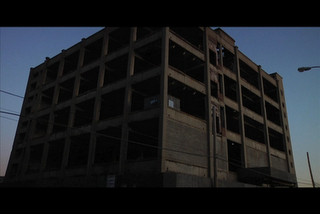
Third, the cinematic techniques I have chosen to use for capturing the temporal existence of these places formulate another temporal component of this project. 360º panning long takes and static shots edited together with the sounds partially recorded on location move the short cinematic studies closer to the real time of the recorded places rather than the manipulative construction of personal and conventional views on the part of the cinematographer. Spontaneous editing was used only for the purpose of assembling the details together into the larger whole but not with the intention of stimulating a third meaning between the shots (ala Eisenstein). In my opinion, details from each location could be easily edited in various ways without paying attention to narrative at all. These places, following Deleuze, could be called "dehumanized landscapes of emptied spaces having absorbed characters and actions, retaining only a geographical description, an abstract inventory of them" (Deleuze p. 9).


Finally, in the end of the cinematographic study, the time-image is freeze-framed and combined with an artificial clock sound in order to inspire the viewer to rethink the relation between the real durational time of these spaces and constructed or abstract time. Summarizing the project, I would hope it could help us to reconsider the temporal, non-representational dimension of cinematic practice as well as re-think the representational image of the city.

Lukas

Saturday, May 22, 2010

The City as a Milieu for the Virtual to Happen, Part One


Guy Debord, the leader of Situationist International, in “Introduction to a Critique of Urban Geography,” introduces the term psychogeography, which means the study of the particular effects of the environment on the emotions and behavior of city habitants. The prevailing mode of acting in the city, according to Debord, is usually controlled and manipulated by the consumerist ideology, which constantly proposes the legitimated actions within the city. Therefore, a representational layout of the contemporary city supports already known redundant practices within it. In this connection, Guy Debord states that the city should be explored without any preconceptions or prejudices. The Situationists criticize the ordinary mundane interactions with a constructed urban milieu and propose the practice of derive. This practice proposes to read the city interpretively, to turn the city around (détournement) and reconstruct it. In this context, the city practitioners see the possibilities (or we can say virtualities) of the city in places of present fragmentation rather than in already known and constructed areas. In my opinion, the Situationists tried to demonstrate the contrast between how the city life practice is effected by representations and what it could be beyond spectacular, representational impact.


In this connection, I found remarkable similarities between how Deleuze describes the attentive, non-representational ways of becoming, for instance, art practice or traveling, and the open city explorations suggested by the Situationists (and to some extent by Charles Baudelaire earlier). As Bergson states, the virtual image is only possible by having the zone of indetermination in our relations with other objects. In this light, Situationist thoughts about their practices remind me of the distinction between actual and virtual images in Bergson and Deleuze. According to the Situationists, psychogeography suggests the possibilities of new findings allowed by the unpredictable influence of the environment on human feelings. So any situation or conduct of a city's inhabitants that seems to reflect the spirit of discovery was understood as a search for something creative and new. Consequently, the Situationists were trying to realize the new practices within the city (spontaneous, unknown in advance), instead of following the mundane routes and actions. Thus, I would say, that an openness to the unknown, the virtual, is essential for an attentive experience of the city. And that is why I found the Situationist approach to the practice of everyday life close to the Deleuzian one.

Lukas

Thursday, April 15, 2010

Sculpting in Time – Giacometti and Tarkovsky


When, 1600 years ago, St. Augustine was asked about the nature of time, he answered that if nobody asks him to define it, he knows what it is; but if he wants to explain it to someone, he can no longer do so. I think that the issue of impossibility of giving verbal expression to time is still viable. According to Bergson (and later Deleuze), perception is subtractive; we are subtracting what we don’t need from the world at the moment of perception; that is why, when we are facing predictable, illustrative signs we perceive them automatically, but when we are in front of concrete duration (time) usually we are unsure how to respond to it; therefore, in this case we perceive the world attentively. In light of Bergsonian-Deleuzian concept of time, I would like to call attention to the potential similarities between two famous (and among my favorite) artists of the 20th century: Alberto Giacometti and Andrey Tarkovsky.

Intuitive feeling of potential affinity between the two modern artists turned out to be the seminal encouragement for me to post this blog entry. Though the title of the book by legendary Russian filmmaker Andrey Tarkovsky
Sculpting in Time is translated as Embalmed Time in Lithuanian, I think that English translation is more accurate than the Lithuanian one, because the former directly refers to the work of a sculptor, which was the intention of Tarkovsky. And, needless to say, Alberto Giacometti is a famous Swiss sculptor who frequently dealt with the concept of time in his artworks. Despite these evident semantic similarities, I was glad to found that both artists could be compared in many other aspects too.

Post-impressionist sculptor and painter Alberto Giacometti started his artistic explorations as a member of the Surrealist movement, but gradually elaborated his own unique style. In 1921 after unsuccessful attempts to finish a simple female bust, Giacometti felt the need to re-think the artist’s and artwork’s relations with time. Later, the Swiss sculptor described his feeling in these (similar to Tarkovsky’s) words: "Before that, I believed I saw things very clearly. And then suddenly it became alien." As a result, Giacometti felt himself cast out of the familiar world of representational forms where everything was known and the simultaneity between the thing seen and its imitation was obvious (Piero, 81). Thus, since this shift, Giacometti’s visualizations were getting more and more temporal than penetrative. The Swiss sculptor was neither mimicking the objects as he saw them, nor was he trying to express the human unconsciousness but, rather, was creating blocks of sensation (as Deleuze and Guattari named them).


As we can see in the photo above (the original artwork can be found in the Metropolitan Museum), Giacometti does not imitate the reality we are familiar with and does not pay a lot of attention to the figure(s) as central parts of the sculpture itself. Rather, the sculptor highlights the intervals in between figures, emphasizing their incompleteness. Spatial distances usually separate the skinny sculptures for which Giacometti is mostly known. Though many of the sculpted figures are in some gesture of motion or stand in the position of which motion might progress, they do not deal with narrative, chronological time. In my opinion, while looking at Giacometti's sculptures we can experience time in Bergsonian terms. According to Bergson, all images exist in relation with the other images in time. Being emerges qua being through movement and time. “Giacometti’s sculptures translate the feeling of time – of present, past, and what his friend Sartre called the 'project' of the future – into spatial relations, the most crucial being the changeful pressure of an empty immensity on the figures that inhabit it,” as W. S. Di Piero points out. According to Piero, Giacometti’s principal work was to manifest the strain of pure becoming (Piero, 84).
Is it possible to compare sculptural image with cinematic one? How could they be related? Andrey Tarkovsky clearly answers this question while describing the essence of the director’s work in his book. “We could define it [essence of the director’s work] as sculpting in time. Just as a sculptor takes a lump of marble, and, inwardly conscious of the features of his finished piece, removes everything that is no part of it – so the film-maker from a ‘lump of time’ made up of an enormous, solid cluster of living facts, cuts off and discards whatever he does not need, leaving only what is to be an element of the finished film, what will prove to be integral to the cinematic image” (Tarkovsky, 63-64).

Similarly to the words of the Russian filmmaker, the Swiss sculptor points out that in his sculptures he wanted to fix the action "as if time had become space." According to Giacometti, “the measure of the image-making process is the squeeze or exhalation of space around the figure, and the continued snags and ravelings of stress within the material itself.”

Hence, in Giacometti’s works time is transformed into space by leaving emptiness (intervals) in it, just as Tarkovsky’s pure optic and sound images (especially, the long takes) stresses a continuously evolving time and are assembled by leaving intervals in narration for the potential not predetermined viewer’s response. As Deleuze puts, Tarkovsky challenges the distinction between montage and shot when he defines cinema “by the pressure of time” in the shot. "What is specific to the image, as soon as it is creative, is to make perceptible, to make visible, relationships of time which cannot be seen in the represented object and do not allow themselves to be reduced to the present" (Deleuze, xii).

Furthermore, Tarkovsky in his book elaborates on the topic of the weaknesses of the representational approach. He states that “film took a wrong turn [...] the worst of it was not [...] the reduction of cinema to mere illustration: far worse was the failure to exploit artistically the one precious potential of the cinema: the possibility of printing on celluloid the actuality of time” (Tarkovsky, 63). In other words, we can easily read (and watch!) Tarkovsky in a Deleuzian way, finding that the cinematic image does not need to hold up the existence of already known representations, to maintain the continuity of the film story and place, in such a way territorializing the time to the sequence of the shots and to the action of the characters. According to Deleuze (and André Bazin before him), cinema has a potentiality of getting closer to reality, creatively presenting the new or the unknown and so evoking new images of thought to the viewer.

It really seems for me that Russian director works closely along the lines of Deleuze, when in the beginning of Sculpting in Time, as well as in his all films, Tarkovsky reminds us that the film material can be joined in another way than is common in traditional drama. The Russian director writes that “through poetic connections feeling is heightened and the spectator is made more active. He becomes a participant in the process of discovering life, unsupported by ready-made deductions from the plot or ineluctable pointer of the author.” He has at his disposal only what helps to penetrate to the deeper meaning of the complex phenomena represented in front of him. Complexities of thought and poetic visions of the world do not have to be thrust into the framework of the patiently obvious. […] it possesses an inner power which is concentrated within the image and comes across to the audience in the form of feelings, inducing tension in direct response to the author’s narrative logic (Tarkovsky, 20).

Thus, despite the differences of the mediums they were working with, surprisingly, Alberto Giacometti and Andrey Tarkovsky could be compared in the way the deal with time in their artworks. Paraphrasing Deleuze, I would sum up saying that both artists attempted to open up the spaces that had been territorialized by representation and imitation (mimesis). Both of them were sculpting in time. Thus, Tarkovsky’s films as well as Giacometti’s sculptures do not consist of images in time but are images of time.

Finally, I would like to ask us to think about what it means to be in time and to create the images of time? I believe that these questions, asked both by Giacometti and by Tarkovsky, are still immensely significant and, unfortunately, are inexcusably often forgotten in today’s art world.

Lukas Brasiskis

References

Bergson Henri. Matter and Memory. The Macmillan Co., NY, 1919
Deleuze Gilles. Cinema 1:Movement-image. University of Minnesota Press, 1986
Deleuze Gilles. Cinema 2: Time-image. University of Minnesota Press, 1989
Piero W. S. D., Out of Eden: Essays on Modern Art. University of California Press, 1991
Tarkovsky, A. Sculpting in Time: Reflections on the Cinema. Austin University of Texas Press, 1987.
Art After Deleuze: From Architecture to New Media. Seminar taught by Sam Ishii Gonzales

Thursday, March 25, 2010

Changes in Public Space: The Smooth or The Striated?


"The Smooth and the Striated" by Deleuze and Guattari and Animate Form by Lynn reminded me a discussion which has been taking place in Lithuania almost for 20 years.

As we all know, the monumental tradition was very viable in the fields of fine art and architecture in the Soviet Union. The ubiquitous monuments were expected to mythologize historical events or personalities which were considered important in the fabricated history of Soviet Union. Using such propaganda, the Soviet authorities were constructing a political identity in the different occupied nations (in other words, this process of “monumentalization” can be called the construction of the historical memory). For the same reason, in the capital of Lithuania, the main public square was also renamed to the Lenin’s name square in 1953. As it was common, in the centre of this square the monument in honor of the first and most known Soviet dictator Vladimir Iliych Lenin was built.

After the collapse of the Soviet Union the monument was immediately removed. However, for almost 20 years the square has been left abandoned. Till now the square has not been renovated due to never-ending discussions about how it should look in today’s independent Lithuania. Eventually, in 2006 the municipality of my city announced a call for an architectural competition, expecting to get new visions for how the square could be changed in the near future. As a result, a few architectural projects were selected by politicians to be further developed. However, the winner has still not been announced and the renovation has not been started.

The interesting reasons and consequences of this situation caused this blog entry. In fact, after reading Deleuze and Guattari text I was thinking about a few possible ways to talk about the aforementioned situation in the light of thoughts about "The Smooth and the Striated."

On the one hand, after the first round of the architectural competition selected projects could be easily divided into two categories, each supported by different groups of people. The projects subsumed to the first category are based on a traditional ideological-architectural approach, whereas the projects subsumed to the second category are based on a contemporary architectural approach.

First category of projects mainly stands for the vertical, clearly visible, symbolic traditional monument, which is expected to territorialize and focalize the space of the square, in the words of its supporters, clearly representing the past by bringing back the memories of their suffering and struggle.


The majority of the older generation, people who were strongly suffering from the communistic genocide, support this model of the space renovation. As you can notice from the image above, the model I am talking about is just another vertical symbolical monument representing the past, bringing back the representation of history again. Therefore, I think it could be a perfect example of the striation and the territorialization of space. First of all the proposed model is going to be clearly centered and vertical, moreover, lines or trajectories of the square’s visitors are going to be predetermined and subordinated to the focal point: the monument. Therefore, the nomadic trajectories and actions are not going to be possible in the square. Even the sights of the viewers are going to be pre-orientated to the unreachable sky – the top of the monument. Moreover, the monument is clearly symbolical, representing religious and national symbols.

On the other hand, there is other category of selected projects, which is mainly supported by the younger generation and which proposes a totally different vision of the square. According to the authors of such projects (below you can see the favorite model), a lot of green public space should be left around or within the square in order to enliven it and make it a friendly place for community gatherings and spontaneous activities and games.


The authors of the project, you can see above, propose to leave the square almost empty with a shallow hole in the middle, which can be used according to he needs and desires of the possible square visitors. In case of this model, the square, for instance, could be spontaneously turned into the friendly place for the skateboarders or it could just be experienced as a place for reading or playing games. To my mind, in terms of Deleuze and Guattari, the second model stands more for smooth than for striated space. In this case, the possible trajectories of movement of the square visitors are going to be unlimited in every direction, the proposed space has neither top nor bottom nor central motive, it does not assign fixed and mobile elements but rather becomes a horizontal plane for continuous variations and potentialities of being in the square. In this sense it is going to be more directional than dimensional space. Incidentally, it is not so representational compared with the first category of the projects. It remains a “body without organs” instead of an organism or organization.

Thus, at first, I found it surprisingly easy to use the antagonism between the two virtual models of the square as the illustration of Deleuzian and Guattarian thoughts about the opposition between smooth and striated space.

However, I feel that the topic would become more complex if we take into account the present situation; in this sense, actions which are really happening in the square right now. As I have already mentioned, due to the collision between two incomparable approaches (first based on historical-nationalistic position and the second one based on contemporary and democratic approach to the space) the consensus about the future of the place still has not been reached.

In the meantime, the square gradually turned into an arena for political-symbolical fights and for a number of unexpected juxtapositions. For instance, a few months ago a group of members of the association of previous political prisoners and deportees (mainly older people) have organized a demonstration and have placed a small symbolical model of their desired monument in the middle of the square. On the other hand, a lot of informal not regulated activities are taking place in the empty, non-renovated, square, too. For instance, recently, an informal flash-mob action was organized in the square. The uncontrolled group of people spontaneously gathered in the square and were blowing the soap bubbles for a half of an hour. Surprisingly, a large number of contributors participated in this event. In light of previous examples, I am curious what we can call this mode of transitional space? In my opinion, the current state of the square makes it a place without a known future, without a known trajectory in time, a space which is filled by events, far more than by form and structure.


According to Deleuze and Guattari, the smooth space does not mean homogenous, quite the contrary: it is an amorphous, nonformal space. In this connection, can the present transitional square be called the smooth and deterritorialized space? And if yes, does it mean that the implementation of any of further selected architectural models (does not matter either first or second one) can only make the place more striated?

Or maybe this example does illustrate that all inhabitated places are in constant temporal becoming from smooth to striated and from striated to smooth again? As Deleuze and Guattari write: “a smooth space emanated, sprang from a striated space, but not without a correlation between the two, a recapitulation of one in the other, a furtherance of one through the other”.

Lukas Brasiskis

Saturday, February 27, 2010

Fluxus Movement as Precursor to Relational Aesthetics


In the last class we had a short discussion about the Fluxus movement and its accordance with Bourriaud‘s ideas about the contemporary aesthetics. Therefore, in order to continue discussion online, I decided to post a few facts that clearly describe the Fluxus movement and also accentuate its similarities to the contemporary relational art practices.


The Fluxus movement, which was influenced by Lithuanian-born artist George (Jurgis) Maciunas, emerged in New York in the 60's, moving to Europe, and eventually to Japan. The movement encompassed a new aesthetic that had already appeared on three continents. That Fluxus aesthetic includes part Dada, part Bauhaus and part Zen, and presumes that all media and all artistic disciplines are fair game for combination and fusion. Fluxus valued simplicity over complexity. This movement of art included a strong current of anti-commercialism and an anti-art sensibility, disparaging the conventional market-driven art world in favor of an artist-centered creative practice. Creative forms that have been adopted by Fluxus practitioners include fluxus performances (events), collage, sound art, music, video, and poetry. In terms of an artistic approach, Fluxus artists preferred to work with whatever materials were at hand, and either created their own work or collaborated in the creation process with their colleagues.

The main features of Fluxus movement include:


1. The Unity of Art and Life
The unity of art and life is central to Fluxism. When Fluxus was established, the conscious goal was to erase the boundaries between art and life. That was the sort of language appropriate to the time of pop art and of happenings. The founding Fluxus circle sought to resolve what was then seen as a dichotomy between art and life. For instance, some Fluxus performances were intended to blur the line between performer and audience.

2. Chance
One key aspect of Fluxus experimentation is chance. The methods and results of chance occur repeatedly in the work of Fluxus artists.

3. Playfulness
Playfulness has been part of Fluxus since the beginning. Part of the concept of playfulness has been represented by terms such as jokes, games, puzzles and gags.
When Fluxus emerged, art was so heavily influenced by rigidities of conception, form and style that the irreverent Fluxus attitude could be understandable. The most visible aspect of the irreverent style was the emphasis on the humor.

4. Simplicity
Simplicity of means and perfect attention distinguish this concept in the work of the Fluxus artists.

5. Presence in Time
Many Fluxus works take place in time. The ephemeral quality is obvious in the brief Fluxus performance works, where the term ephemeral is appropriate, and in the production of ephemera, fleeting objects and publications with which Fluxus has always marked itself. Fluxus performances were usually brief and simple. The Event performances sought to elevate the banal, to be mindful of the mundane, and to frustrate the high culture of academic and market-driven music and art.


In my opinion, the aforementioned features of Fluxus movement (especially, a time based non-formalistic approach to the artworks, a critique of the institutional market-based art system and a participatory character of the Fluxus events) let us question the novelty of contemporary relational art practices described by Bourriaud in his book Relational Aesthetics. On the other hand, Fluxus movement was very broad and diverse (the discussion about its time and geographic limits is still viable among the art critics), so its description is relative and can hardly be terminative.


Lukas Brasiskis


References:

1. Friedman K. Forty Years of Fluxus, The Fluxus Reader, 1998

2. http://www.fluxus.org

3. http://en.wikipedia.org/wiki/Fluxus

4. Williams E., Noel A., Ay-O (eds.) Mr. Fluxus: A Collective Portrait of George Maciunas 1931-1978, 1998

Wednesday, February 24, 2010

The Issue of Form in Bourriaud’s Texts


When I first had read both Bourriaud’s texts I felt slightly confused because of difficulties to understand why the author in each text proposes different approach to contemporary art. For instance, in his first book Bourriaud advocates that contemporary artwork does not have a static form anymore. He states that it is in the constant state of fluidity now. According to Bourriaud, contemporary artwork gets a temporal form only in relation to other human. But then, in Postproduction the author claims that “all observed artistic practices […] have in common the recourse to already produced forms” (Bourriaud 2001, 16) and so, in my opinion, have a formalist nature.

But then I decided do not take into account these probably natural differences (because of slightly different art examples he gives in each text or slightly different time he observes) and, instead, I tried to find the significant similarities in Bourriaud’s approach to contemporary art.

“The new is no longer a criterion”, Nicolas Bourriard writes about the significant changes in the contemporary art in the introduction of his Relational Aesthetics (Bourriaud 1996, 13). Later in Postproduction Culture as Screenplay: How Art Reprograms the World, French art critic goes further and points out that contemporary artist is not obliged anymore to create something originally new in terms of the raw material or system of signs, but, rather, works as editor or DJ who mixes pieces from the old artworks puts them in the new contexts and, finally, gets the new meanings. Both, in his earlier book Relational Aesthetics and in Postproduction Bourriaud quotes Deleuze in Negotiations: “grass does not grow from the roots or from the top, but from the middle” (Bourriaud 1996, 14 and Bourriaud 2001, 17) and explains that this describes the situation in which contemporary artist is. This means to Bourriaud that artist is not able to make something new anymore, he can only deal with forms that surround him in the present moment.

After I had read Bourriaud’s works I remembered a short video project “Revisiting Solaris” by well-known contemporary Lithuanian video artist Deimantas Narkevicius. Following the narrative of Stanislaw’s Lem’s book Solaris, Lithuanian artist shot the additional scene which was excluded during the book’s adaption in the famous Andrej Tarkovsky’s film. The scene is based on the last chapter of Lems’ book, which had been left out of Tarkovskij’s version. In this scene, the main protagonist Kris Kelvin reflects on his short visit to the planet Solaris shortly before his return from the space mission. In Narkevicius project Kelvin is acted by the same Lithuanian actor Donatas Banionis, who is 30 years older now. Furhermore, the setting of the planet Solaris is created using the photos and paintings of the most known Lithuanian painter and composer Mikalojus Konstantinas Ciurlionis. Ciurlionis was a modern symbolist who in his paintings usually was dealing with the topic of the mysterious relation between space and nature.

In my opinion, “Revisiting Solaris” confirms Bouriard’s argument elaborated in his book Postproduction. Deimantas Narkevicius really makes use of three different existing narratives or mediums (using the words of Bourriard): existing paintings and photos, existing book and existing film, mixing them together and creating new artwork, which is also is extension of the previous. Citing Bouriard: “In this new form of culture […] each exhibition encloses within the script of another; each work may be inserted into different programs and used for multiple scenarios. The artwork is no longer an end point but a simple moment in an infinite chain of contributions” (Bourriaud 2001, 20). Narkevicius in his video installation “Revisiting Solaris” did exactly that.

Though Narkevicius video installation was really impressive, on the other hand, while reading Bourriaud I was thinking how we can talk about the perception of the artworks from the standpoint of Bourriaud? And how we can define a quality (both in terms of form and content whose are interchangeable) of the contemporary artworks? For instance, if we are taking into account the aforementioned video instalation by Narkevicius, despite that it is extends the narrative of Tarkovsky’s film, this video work is certainly becomes more representational than Tarkovsky’s film was. The author of “Revisiting Solaris” uses already known story (the narrative of the film) and already seen images (the main actor, similar setting, known photos and paintings) in order to create an extension of the Tarkovsky’s story. Thus, my following question is: could a post-produced artwork still move us towards the realm of the un-thought, which leads to a new image of thought (as Tarkovsky’s time-images definitely do)?

Lukas Brasiskis