Much has been written over the semester about Marina Abramovic’s exhibition at the MOMA, and all of the entries have provided us with fascinating perspectives on the experience.I visited the MOMA again recently, and was intrigued by how a shift in the crowd’s energy had a major influence on the exhibit overall.It seemed as though a reverential energy enveloped the space, unlike my initial visit.The first time I visited the exhibit, the room had a strange buzz of energy that did not quite seem to fit the performance properly.This was apparently due to some celebrities that had recently participated in the performance, and many of the people seemed to be there to try and catch a glimpse of someone famous instead of experiencing art.However, my recent visit left me with a vastly different view of the performance.
Before entering the exhibit, I had visited some of Duchamp’s pieces.There was a quote of his that appeared in our discussion of Nicholas Bourriaud’s writings that kept coming to mind.Duchamp states that, “Art is a game between all people of all periods.”This was running through my mind as I watched Abramovic’s performance, and seemed to have an influence on my overall experience.I found the relational aspects of the exhibit to be more powerful than my previous encounter.When I returned home, I read parts of Bourriaud’s Relational Aesthetics again and felt that this passage was a perfect description of my time spent at Abramovic’s exhibit:
The form of an artwork issues from a negotiation with the intelligible, which is bequeathed to us.Through it, the artist embarks upon a dialogue.The artistic practice thus resides in the invention of relations between consciousness.Each particular artwork is a proposal to live in a shared world, and the work of every artist is a bundle of relations with the world, giving rise to other relations and so on and so forth, ad infinitum. (1)
I felt as though this helped to explain why my initial experience was not as interesting as my second visit to the exhibit.I realized that I did not fully allow a dialogue to take place with the art itself.I was too caught up in other things to have a full encounter with the art, and forgot to uphold my part of the relational art experience, thus was not able to fully engage with the work.
I was pleasantly surprised by how much I appreciated the coverage of the exhibit on the MOMA’s website.It definitely serves as an extension of the exhibit itself.I found that I have watched the live stream of the performance from time to time, and am always immersed in footage.I appreciate how we are able to access the website in order to reunite with the relational experiences that we first encountered at the exhibit.It also made me wonder at which point the interactive aspects of the website were incorporated into the exhibit overall (was this first considered by Abramovic during the initial conception of the exhibit, or was it primarily designed by the MOMA?).
When Beom presented his project in our final class Wednesday night, there was some confusion as to whether the "work" itself was his sculpture, or the photos of his sculptures, or his lecture referencing the photos of his sculptures. His response was that it was not important to delineate between those processes or titles, since the "work" itself was composed of all three steps.
This nebulous mutation of art – a kind of constant coming-into-being within multiple different media – seems to me to be the most important recent development in contemporary art practice. It is both indebted to and contrary to Deleuzian theory in that his writing focused on singular works of art (i.e., in a single medium format) resulting from the artist's dynamic encounter with the ever-changing percepts and affects of the world. Yet the concept of creation-as-mutation is integral to work such as Beom's and the examples of 'relational art' and participatory, affective-response works profiled by Bourriard and Hansen. The implication is that Deleuze's 'becomings and trajectories' have moved from the stage of fabrication to the stages of conception, presentation, and reception – with fabrication now relegated to a supporting role to facilitate those stages. Artists are no longer passionate material craftspeople but thoughtful stewards or choreographers shuttling an idea through its various forms and ever-expanding applications. This change can be seen in all arts, from painting to music to sculpture to film/video, and it is being grappled with in widely varying ways.
Take the works on view this year at the Whitney Biennial. If this is any indication of the state of contemporary art (and maybe it is, maybe it isn't), confusion and apathy seem to reign. There is a paucity of moving or passionately conceived work in the exhibition, and after seeing it I felt as cynical about the power and potential of art as the majority of artists represented in the show seem to be. Though I don't follow the discussion closely, I know the various Biennials are highly political, buzzy, pop-culture events within the art world, and there are intense debates concerning their rigor and credibility. Leaving that debate aside, I'll focus on the Whitney exhibition in the context of our class material.
It seems as if many artists working today are unmoored by the shifting nature of art's "body." More often than not, their response is to simply literalize that concept – usually with disappointing results.
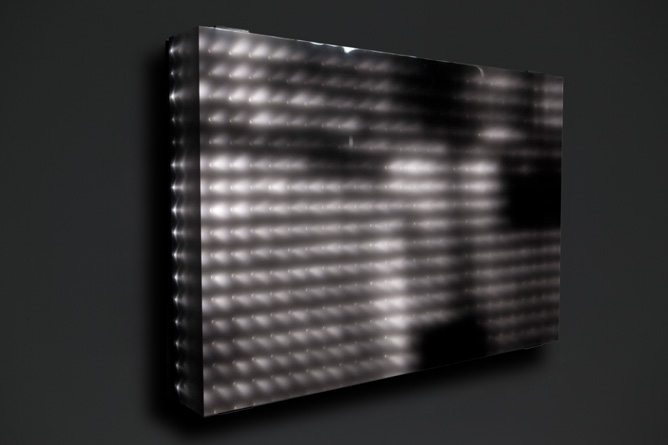
Some works attempt this through invoking a physiological affective response in the viewer (a la Jeffrey Shaw in Hansen's New Philosophy for New Media). For example, R.H. Quaytman's optical pattern silkscreens unsettle the eyes and therefore the body for no apparent reason except to foreground the 'nature of perception' (that old standby!) and skillfully invoke the building window that inspired them. Even the artist's statement cancels out the possibility of any determined aim. (“I seek to maintain and simultaneously disrupt painting’s absolute presence.”1 ) Uh, okay. So it's about non-space or non-presence? In relation to what – interior design?
The other common approach to literalizing art's shifting mediations is to obscure the work's affiliation to any particular medium. Because everything is art nowadays, nothing is – it is all derived from other areas of visual reproduction, and curators seem reluctant to draw hard lines between genres for fear of seeming conservative or limited in their thinking. Several works at the Whitney capitalize on that confusion and "inclusiveness." Pae White's smoke tapestry, Charles Ray's willowy flowers, and Aurel Schmidt's detritus-as-beauty drawings are primarily works of graphic design, illustration and political cartooning, respectively, that seem to have talked their way into the art exhibition circuit. The documentary photographs of Stephanie Sinclair and Nina Berman are powerful examples of photojournalism at its best, but they have nothing to do with the plane of immanence into which an artist, according to Deleuze, must enter in order to construct something new from the world.
To be fair, this confusion does not necessarily originate in the artists, as art institutions dictate to some degree the playing field. Case in point, the Whitney's description of this year's Biennial is totally noncommittal ("…simply titled 2010 [it] embodies a cross section of contemporary art production rather than a specific theme" 2 ….to which I'm tempted to ask, "Then what are we paying you for?"). It's true there isn't much of a theme among the new works, except perhaps "creepy suburbia" (e.g., Josephine Meckseper's "Mall of America," James Casebere's "Landscape with Houses", Duane Hanson's lifelike sculpture of a middle-aged housewife).
Rather than simplistically literalizing or trivializing the process by which art is shifting form, blurring genre boundaries, and engaging viewers in disorienting ways, some artists are attempting to engage with this ambiguity in genuinely risky ways. Duane Hanson's sculptures are rigorous in their conception and execution; their careful fabrication process seems to require the artist's personal engagement with the affects and percepts of human figuration, while forcing him (and us) to grapple with figurative sculpture's transition from idealized portraiture to arbiter of decaying social relations.
Among the video works, Sharon Hayes' "Parole" applies skillful filmmaking techniques to portray moments defined by body language and movement (e.g., interviews, interrogations, and dance) and creates an immersive environment for the viewer in which screens and sounds layer upon one another, building in relation to the timing of the viewer's entrance into the space. Like the immersive projection environments of Aernout Mik, this work is passionately political yet nebulous in its aesthetic footing and genre classification. There is a sense we are on a journey with the artist through the works' multiple permutations – as if the images' independent juxtapositions and interactions (the "something that goes beyond testimony to the photographer's art" described by Walter Benjamin3) determines the outcome. The work does not exist solely inside the frame of the images, but in the conflagration of all the screens interacting at once, through and without the viewer – who may be a witness or a participant to the videos' content.
Whether successful or not, today's questioning, unsettled art works show that we are grappling with a new kind of practice whose trajectory must cross not only different media forms but different states of being, in order to become whole. With regards to my own web-based and film/video projects, which feed into and grow out of one another in various shifting ways, I am discovering that the creative process is a kind of constant reconfiguration (Bergson's 'kaleidoscopic' assemblage of images in relation to "the privileged image" of the body4). With no fixed entry or end points, this process unfolds within the germinating pool of ideas or images that I find myself constantly revisiting in one form or another.
Thanks, Sam and everyone, for a great class. Happy summer...
3 Benjamin, Walter. "Little History of Photography," The Work of Art in the Age of Its Technological Reproducibility, and Other Writings on Media, ed. Michael W. Jennings et al., trans. Edmund Jephcott et al. (Cambridge and London: The Belknap Press of Harvard University Press, 2008), p. 276.
4 Bergson, Henri. “Of the Selection of Images for Conscious Presentation,” in Matter and Memory, trans. Nancy Margaret Paul and W. Scott Palmer (London: George Allen & Unwin Ltd., 1911), pp. 12-13.
The Whitney Biennial 2010 validated a problem I encountered with the same museum six years ago: the fetishism of theory. I do not know if it is from the curators or the artists, but there is a tendency to finalize the experience of the artwork with overreaching statements. While I did like some of the work displayed, I will not go into details about them. What bothered me was that after looking at the artwork, I read sentences that I found perplexing. I felt like I was reading something movie commercials on TV would do. One superimposed text for commercial for Taken (2008) read, "Move over Bourne, here comes the next action hero." The former film is about human trafficking; The Bourne Identity is a film about espionage. Of course, the movie industry was forcing the action angle, and it seems that the Whitney was the authority of ideas, as Hollywood is the authority of wish fulfillment.
The "art world" theorizes like a secret that visitors stumble upon, yet this secret is revealed because it conceals a problematic within the art world: the art definition. Words like "Surrealist can draw romantic flights of the style, "weird" or "avant-garde." Instead of allowing viewers to exhibit the artwork, the curators allowed statements to represent the artwork. As a result, there is a severe disconnect between what you read and what you see. For instance, part of the description for "Michael and Charles," by Lorraine O'Grady, claims that the pairing of the pop singer and poet is "raising issues of class, race and the highly ambivalent nature of beauty that the new abstraction ignores." So Michael is black/Negro/African American, and Charles is French. Am I supposed to validate the ongoing struggle to demote white superiority? Are Jackson's standardized pop songs superior to Baudelaire's poems? Are they compatible? Hindering this line of thought I'm supposed to follow is a white ambulance/hearse in the middle of the room, spewing a female voice. Am I supposed to appreciate the photographs by being distracted? As for the "highly ambivalent nature of beauty," I guess those ads for Gap, Mabelline, and Calvin Klein make ambiguous statements. Why do women wear make-up, and why do men unbutton their buttoned shirts?
The plague of catchwords disseminate the infect visitors with the 'oh" response, so that they can proceed to the next artwork and nod along. Thus, the plaque narrows discourse by imposing an ideological wall, where one the other side "they" know what's going on with art these days.
Once I stood in front of Rothko's painting for a long time. It was one of his nameless compositions of two or three blocks of colors. I was looking at the big block of dark brownish grey that was divided by a dark brownish red horizontal line, while remembering his words that he wanted to make people cry while standing in front of his paintings. And I was watching and waiting, although for no particular moment. It was just myself giving way to the painting, the colors, the blocks, the darkness. I was wondering about how a color could make one cry. Then a very old thought came to mind. When I was a teenager and first encountering some philosophical and sociological proposals of the world and how it should be changed, with all of their arguments and contra-arguments, at one point I concluded for myself, since, obviously, none of the theoretical plans were working and all of them seemed to be too specific, too deterministic, that an "elastic" system must have been created – at the same time general and specific, one that would indeed carry in itself an idea of the whole (of the world, of the society), but at the same time, the one that would constantly be directly addressing an individual, whereas its elasticity would give him/her the space for individual choices. And all of a sudden I saw a portrait on that dark color block. I flinched. I stepped away. There was an en face dark head coming out of the canvas. We were facing each other. I moved back, toward the painting, to look closer for I thought I was imagining things. I looked away and then back at the canvas and it was still there. I realized that I was looking at myself. The canvas became a mirror. It was disturbing, as it wasn't reflecting my features or any of me that I had known in the mirror. Since it was a noncolor and nonpicture – just a contour, it wasn't suggesting any claims about myself. I was faced with an empty darkness of myself. I had no external or concrete claims about myself to contradict or agree with – in a word, to discuss. I was left alone. To myself. I was left only to observe at first, and be led by an internal impulse. But the impulse was not directed by any external ones, except for the impulse to watch. And the piece of art was offering that defamiliarized look at the inside of myself, at my own soul. Its abstract form that goes into its own absolute, into almost noncolor, into almost nonshape, into nothingness, was creating space potent with a new form, an internal one – the one that I may create while watching it – watching myself, until I reach the decision to re-create myself – to become, once again. And, it is a choice, because, in the living being, individuation is brought about by the individual itself (Simondon, 305). Full stop.
Vladana
p.s. In case anybody reads this and becomes curiously suspicious, the painting (which formal name I wouldn't know) is hanging in MET, just a few steps away from Damien Hirst's dead shark.
Tonight I'll be making a presentation on the work young French conceptual artist Cyprien Gaillard, whose practice includes video, performance, sculpture, photography and land art. I'll mainly be discussing his video art, which is what he's best known for, and its relationship to architecture, and how his work activates many concepts we've discussed throughout the semester, particularly pertaining to Deleuze and Guattari's concepts of the smooth and the striated.
You can read a recent essay by Gaillard in ArtForum, wherein he discusses his interest in modern ruins, and watch the following video, Pruitt-Igoe Falls (2009), his second-most famous work to date (I'll be discussing his best-known as well, which only exists online in impoverished snippets, but you may have seen at the New Museum last year in The Generational: Younger Than Jesus, and is discussed at great length here). I will also show it in class this evening. See you then.
During our discussion on Wednesday one of the major shortcomings we found in Mark B. N. Hansen's New Philosophy for New Media (2006) was the absence of any engagement with video games. This struck us as especially problematic since his whole project seemed to be a consideration of the ways that qualitatively new media allow us to engage with them in an affective, embodied manner, and this certainly sounds like the kind of experience we have whenever we play a video game, be it an old coin-operated Pacman arcade game or a brand new Wii game at home or World of Warcraft on a computer. Surely Hansen would not be able to liken this activity to the so-called "enforced passivity" of the cinema that he seems so resolved to criticize. But then how would he be able to maintain a distance (as he would presumably want to do) between the work of Jeffrey Shaw that he is so committed to, and something like Second Life, Halo, or even Tetris? I think we might extract and extrapolate some (relatively positive) evaluation of video games from Hansen's critique of Liev Manovich's The Language of the New Media (2001), and the treatment of virtual reality (VR) therein, near the end of chapter one of New Philosophy for New Media.
In this passage Hansen criticizes Manovich's evaluation of VR for failing to fully take into account the embodied experience of the user during and despite the experience of being also virtually embodied, or virtualized. He asks: "Can the reality effect of telepresence be understood without an account of the physicality of the virtualized body?" (40-41) He suggests, in other words, that new media such as VR enable the user to be doubly embodied, both in the "original" space of the virtualizing interface or console and within the virtual world, in a digitized body. While Manovich suggests that the latter nullifies the former for the duration of the VR experience, Hansen argues that both must be partial and simultaneous, leading him to propose what seems a very radical (and very Deleuzian) realignment of the conventional opposition between representation and simulation, one that can be useful for constructing a Hansenian theory of the video game. He writes of Manovich: "the example of telepresence underscores the limitations of his general distinction between representation and simulation and suggests the necessity of triangulating this binary with a third term, namely, hallucination (by which I mean... that the embodied mind actually creates what it sees)" (41, emphasis original). One final quotation (in which we might substitute "video game" for "VR" to fully understand how these comments apply to the former medium): "that explains the capacity for the VR interface to couple our bodies with (almost) any arbitrary space, and not just spaces that are contiguous with the physical space we happen to occupy or even spaces like those we typically occupy" (41). This triangulating, hallucinatory property that Hansen invests in VR can very easily be seen as the starting point for his (perhaps surprisingly positive) evaluation of video games.
Video games, like VR, must then trigger this phenomenon of being in a doubly embodied, hallucinatory state, activating a virtualized world while still remaining an affective body within the world of the gaming interface. Certainly the increasingly frequent appearance of artist-designed video games in art spaces corroborates this characterization. In the exhibition The Generational: Younger Than Jesus at the New Museum last year, video game artist Mark Essen presented a game of his called Flywrench (2007), in which the player uses a controller to navigate a flying wrench through a series of increasingly labyrinthine spaces while trying to keep the fragile object from shattering. The unique telepresence of this game takes us to an environment that is certainly not "like those we typically occupy," requiring us to assume the position of a typically inanimate object (a wrench) endowed with the superhuman ability of flight. Playing the game, however, also meant standing in a museum gallery (there was no seating, perhaps to discourage visitors for hogging the one controller for too long) surrounded by other visitors, some of whom might be watching you play, hearing sounds from nearby installations and videos. Perhaps not an ideal gaming environment, the Flywrench installation illustrated Hansen's phenomena of triangulation and hallucination in a decidedly active, rather than passive, setting.
An installation at last spring's Offf Festival by the Spanish design firm Multitouch Barcelona pushed this capacity for simultaneous, multiple embodiments to the extreme, creating a wall-sized projection of the vintage arcade game Space Invaders (see video at the end of this post). Gallery-goers played the game not by pushing buttons on a controller or joystick, but by throwing projectiles like tennis balls at the projected images on the wall, where a sensory surface detected the hit, destroying the enemy ship, if there was one, in that spot. Anything but passive, this throwing game has the further advantage of being a multi-player experience, adding a sense of temporary, communal embodiment very different from the solitary VR experience that Hansen describes.
Another video game artist, Erik Svedang, has created a very immersive, but just as graphically simple gaming environment called Pixel Cave Adventure (2007, pictured at top), in which gamers play within a small cube surrounded by four screens, directing a small human figure who moves around the panoramic maze surrounding the player. Parallels to the work of Jeffrey Shaw, as discussed by Hansen, are inevitable, though here the simultaneity of embodiments is perhaps more extreme, allowing the gamer to control a solitary humanoid character while at the same time having to move and turn around in the claustrophobic space of the gaming cube.
These examples of how we might imagine Hansen's hallucinatory theory of VR being applied to video games all involve site-specific installations, but a simpler game that exists online for free might demonstrates the VR-video game analogy as well. First-Person Tetris begins much like the original game, presenting the gamer with a vertical, rectangular space and falling blocks that must be arranged to create solid lines. The space of the game is surrounded by a conventional living room setting with television, carpeting, a houseplant and video game console. But as the pieces move downwards so does the entire screen. Rotating pieces to fit them into the increasingly complex geometric gaps makes the entire screen rotate. As the game's title suggests, we are challenged to assume the point of view of these abstract blocks of forms and color, a perspective that stands in sharp contrast to our embodied presence in front of a computer screen. Aside from provoking a surprisingly acute sense of Hansen's hallucinatory double embodiment, First-Person Tetris is liable to provoke nausea, pushing our capacity to inhabit both the virtualized and physical spaces at once nearly to its breaking point. Such innovative video games offer extremely interesting and promising activations of Hansen's concept of multiple embodiments and the hallucinatory relation between representation and the virtual in VR. Though he never addresses the potential of video games for triggering qualitatively new experiences and embodiments, we can surmise of his engagement with VR that he may have identified a surprisingly optimistic potential in this new medium.
-Ben Sutton
Here is a short video of the interactive, wall-sized Space Invaders projection by Multitouch Barcelona at the 2009 Offf Festival:
Perhaps because I was so completely taken by the Marina Abramovic exhibit at MoMA last week - I'm still thinking about it and still bring it up in conversation with friends back in California - I found it difficult to process all of the information thrown at me at the Whitney Museum's Biennial show last Friday, April 30th. Only almost a week later have I been able to reflect on what I had seen and what struck me and remained imprinted on my memory.
I showed up at the museum equipped with the knowledge of one, maybe two of the artists whose work was on display, completely unfamiliar with the rest of the pieces and the artists in the show and completely unassuming in what to expect. I'd heard a lot of hype, namely that this year's show was the best in ages, but digesting this hype felt similar to times when friends have told me that a film is "amazing" or "hilaaarious!" - I knew that expecting too much could potentially disappoint. I suppose that since this show is supposed to be the show that features the next big stars of the art world I should have done a bit more research - but honestly, wandering the labyrinth of temporary walls and installations with a map and a checklist wouldn't have done me any good at all. Instead, coming in blindly allowed me to stay longer when I wanted to stay and move on quickly when something didn't catch my attention or peak my interest.
Having the collective experience of viewing the Bruce High Quality Foundation's piece I Like America and America Likes Me was a unique moment in the visit, being the first and last time that all seven of us experienced a piece together through interaction and conversation. I don't know that everyone was equally intrigued by this piece, nor am I asserting that everyone will remember it - but from this point on, after viewing the BHQF's Hearse converted into an ambulance with the windshield functioning as a screen for a slightly distorted video piece, each of us will have a unique selective memory of those pieces of art that matter the most to us for one reason or another. For that first shared experience, we all were able to experience something together, although this is not to say that all of our experiences were the same nor that all of our memories of the shared experience will be the same.
Fascinating, though, how each of us will come away from this and write something different about potentially disparate or potentially the same works. After we all parted ways and completely lost track of each other, each of us were able to take as much time as we needed looking at every piece of art that interested us, in a way being allowed to choose the most desired path for our own unique experiences. I had several passing moments with everyone, "dancing" with Susana a few times, sitting silently next to Caldwell during Kerry Tribe's video piece HM (which I fully intend to write more about once I feel that I can effectively compare it to Bergson), but rarely speaking with any of them in the hopes of maintaining our own unique, uninterrupted experiences. I don't necessarily enjoy conversing at a museum anyway both for fear of being rude or disturbing other patrons and the desire to quietly contemplate and live in the moment. This is why I agree with Sam's point that museums and art in general are sometimes best experienced alone - I think that Brian trying to be friendly and speak to a completely engrossed and therefore barely responsive version of myself while I was watching Abramovic's Rest Energy at MoMA is a testament to the point that art is sometimes best experienced in solitude - but, this is not to discourage the potential for an enlightened, collaborative conversation afterward.
Nina Berman's set of photographs called "Marine's wedding" is for me the strongest work of all shown in this year's Whitney biennial. It is a startling fusion of social and personal matters, politics and private life affairs, heroism and daily life survival, an extraordinary will to succeed and a failure - all in a single narrative and with the most modest means of a casual photograph. The earliest photographs of the disfigured Marine sergeant Ty Ziegel have been taken by the artist in the weeks preceding his wedding with his fiance Renee Kline. The tension in the relationship, the pressure of mutual obligations and growing estrangement are palpable in these images. The wedding portrait is especially striking. Still, the work would not have been complete without the photographs of Ty taken by the artist a little later, after his divorce with Renee. They are both reassuring and disturbing: they show Ty settled in his new life more or less comfortably, accepting his condition - and also embracing the military culture despite the cost (a photograph of him holding a gun with his right hand and the stump of his left hand is especially unsettling). These images raise so many disquieting questions - of the crime of war, the notions of duty, and of our inability to believe that a personal sacrifice to a great cause might be a mindless blunder. The issue that resonates most with me, however, is the one of personal identity and change, which Berman's projects evokes in such a painful way.
Is the disfigurement of the body affects a personal identity? Is Ty recovered after the bombing the same Ty his fiancee had known before? Does the moral obligations towards the "old" Ty still hold towards the "new" Ty? What is the personality, after all? Is it in the body, in the mind, in the sum of person's experience? How is the self-identity preserved despite the changes in the body or mind? The questions of identity and personal identity are among the central themes of philosophy, but as any philosophical question, they never get resolved or even explored sufficiently. One of the earliest views (e.g., Plato, Descartes) suggests that the personal identity is associated with immaterial substance (soul or mind), which is independent, though closely related to body and controls it in a way rather similar to how a pilot controls a his ship. A rival (materialistic) view would of course posit identity of a person in the substance of his or her body. In the late 1960s John Locke proposed a novel approach to thinking about personal identity and identity in general. He distinguished between the identities of atoms, groups of atoms and living thins. An atom does not change over time, so its identity is self-determined at any moment. Identities of groups of atoms are defined by their constituent atoms, regardless of the ways in which they are organized. Identities of living things (and more broadly, functional objects) are defined by their functions. The functions may persist in the objects despite changes in their structure: so a computer with a new mouse or a keyboard is the same computer; while the non-functional collection of the computer's part is not the same computer anymore. The most important function for living things is the continuation of life; regardless of structure and organization, the same life provides the criterion of identity for anything living, be it a dog or a bee. Therefore, the identity of a man is defined by his living body. This view, clearly, shifts the question of identity from substance to function.
However, Lock proposes an additional criterion for personal identities of humans. The identity of a person (as opposed to "man", a biological organism) is defined by psychological continuity: a person A before a certain event is identical to a person B after the event if person B is psychologically evolved out of A. Therefore, personal identity "depends on consciousness, not on substance". A thought experiment, in which a a prince's mind which enters the body of a cobbler, may be used to illustrate this view: a prince's consciousness in a cobbler's body defines his identity as that of prince's, despite his body being identical to that of the cobbler's. The definition of personal identity based on the psychological continuity, however, raises other problems. For example, if a person is unconscious or asleep, how is his identity determined?
Deleuze's lifelong project was his attempt to establish the ontology of difference. In a traditional view, difference is thought of as a relation between two terms with predetermined identities and as such is subordinated to identity. In Deleuze, on the contrary, difference is a transcendental principle. Different terms are related through difference itself, without any reference to identity. Accordingly, personal identity for Deleuze is in the process of individuation (notion derived tom from Gilbert Simondon's theory). His view seems to agree with many of our personal intuitions about ourselves. We would not equate ourselves with the infants that we had been at some time in the past. In some instances, we feel strongly that our personal identity is drastically different from that a year or 5 years ago as a result of an accident, a move to another country, or a decisive change in life such as a death or birth of someone dear to us, etc. Our bodies and minds are in the process of continuos transformation, which defines what we are in every single moment. At the same time, many ethical questions seem to be inseparable from the notions of stable identity. After all, what justifies our holding a person morally responsible for some past action? And what would be the moral obligation of and towards a person ever transforming through the ongoing process of individuation? Deleuze seems not to be particularly interested in ethical questions that arise with the process-based definitions of identity, but this may be a rich a challenging subject for Deleuzian philosophers. I can only vaguely imagine the principles of of such process-based ethics (a fascinating and possibly terrifying view).
Below is the link to Nina Berman's personal website with the photographs from "Marine's wedding" http://www.ninaberman.com/anb_port.php?dir=mw&mn=prt
It always annoys me that one is not able to take photographs or video while wandering through museums (at least in NYC; the same rule didn't apply the last time I was at the Georges Pompidou Centre in Paris). While I appreciate the fact that it saves me from having to view tourists gathering around art objects for a photo – indeed, now that I think about it, maybe it's not such a dumb rule after all – I still resent the fact that one can only do this (take a photograph) clandestinely. For me, often the most interesting "visual" within a gallery space is not found in the art work itself but in the relation that is established, or not, between work and spectator. I like to see the art work refracted through the movements – or stillness – of the museum's visitors, sometimes huddled in masses; sometimes exposed and alone. I particularly like when the latter occurs, which rarely happens in the cluttered spaces of NYC museum spaces. It was thus nice to see less, rather than more, at the more modestly-scaled Whitney Biennial 2010, although I think they should have cleared another floor for the new exhibition, giving the works even more "breathing" room. Above are three (illicit) images from Ari Marcopoulos's Detroit, projected on a wall-sized screen in a large, mostly empty room, as part of this year's selection. (Note the size of the image in relation to the emergency "Exit" sign.) By this point, I had lost track of where most of the students had gone – ciao Susana, Brian, Caldwell, Maria, Raul, Lukas, Katherine – and it was okay. Art needs a bit of solitude. I like too the experience of leaving such an event and re-entering the "real" world alone. This is what we need more time for: art and solitude. Indeed, what is art except this ability to experience – however fleetingly, however momentarily – a bit of solitude from a world that assaults us at all times and on all fronts. A solitude that allows us to return to the world with renewed interest and attentiveness (the world in all its depth and opacity) as well as a renewed commitment to resistance: to resist the false solicitations that lead us to trivialize the world and ourselves.
The end of the semester draws near and I feel like posting blogs has become somewhat of a salmon run, so I'll write something short. Today I went to the Whitney Biennial. Of the many fantastic and not so interesting works I became interested in Kerry Tribe's Making Memories, which is a short docu-bio about the patient H.M. who is put on screen, interrogated, interviewed and commented on by doctors and neuroscientists. Patients who are referred to by their initials do so in order to remain anonymous. It is incongruous then that we are given some very intimate images of H.M. that reveal a very private space. The film which consists of two projections side by side (analogous to the relationship between right and left hemispheres) is the study of H.M.'s post mortem hippocampal memory. Perhaps then it is significant that his name remains unknown to us, that he remains a patient. What we observe is a becoming memory, and not simply a portrait of an individual, who in any case, because he has lost the ability to record new long-term memories, is not entirely sure of his own identity. We know more about H.M. in fact than he does, and in a way adopt his identity by inferring certain things about his life. The two screens cause our attention to jump, lose record of one image in exchange for the next, simulating a kind of short-term amnesia. The two screens create a gap, which is the space of the not-remembered or the forgotten. In normal healthy subjects change blindness is part of our everyday world. When momentarily distracted we may miss entire details of a person's face or even happenings in the world. One famous test is that of switching agents or objects in front of a subject during a moment of distraction. The subject may or may not be conscious of the fact that there has been a switch and continue interacting with what they perceive to be the same object or person. I feel that Kerry Tribe does a good job in bringing out our own vulnerability when it comes to making memory and recalling our identity, while also remaining true to her subject.
My second blog post is again less a theoretical investigation on a particular matter than a question or an experiment.
I have to admit that the recent show of Marina Abramovic does less strike and entertain me because of the artworks themselves (although I have to say that I respect and appreciate her body of work very much) or because of theoretical references we tempt to force on art works; rather it interests me as a new step or understanding that she provides us on performance art. I am not sure whether this is a critical point or it is just how performance art is developing in its organic way and whether there should be less resistant against this development. We'll see.
But what I mean with a new step in performance art is that I think Abramovic denied a very specific element of performance art which is the event, the actions performed on-site and on the specificity of time. Time specificity and site specificity. So what happens if we deny this element and just concentrate on the concept or the script of the performance? A script which usually is in itself open and again based on the site and the time in which it will be performed. Even the term 'to perform' is in my opinion not the right term. But because of the lack of English I can not suggest another term at this moment. So what happens here if we just take the script and the plan of an already happened event/performance; what happens if just take the documentation of it and let it be re-enacted by other performers? Can we still talk about performance art? Or are we talking about objects? Isn't it the same as 'living sculptures' of Gilbert and George?
In the case of Marina's 'The Artist is Present,' I think that all we perceive in her show are objects in the form of documentation material or sculpture. Nothing there is time- and site-specific anymore. Everything is ruled by a plan. Even the exhibition design was based on the plans and scripts of the performances. There is no space for process. There are guards and rules who tell you how to be in this space. Everything is an re-enactment and theater. It is nostalgia. It is past. The artist is not present. The artist is object. The artist is past. And I will be able to buy the artist.
In this week’s reading from New Philosophy and New Media (2006), Mark B.N. Hansen lays out the foundations for his theory of new media art, rooted in a phenomenological, Bergsonian understanding of the way artists and audiences engage with such data. The work of photographer, digital video, new media and installation artist Jim Campbell engages and illustrates many of Hansen’s ideas regarding embodied vision, and its role in framing the flow of digital flow of data for every viewer, in his current exhibition Exploded View (through May 22, 2010) at Bryce Wolkowitz Gallery. Arguing for the radical newness of new media art in the face of dismissive evaluations like those of Rosalind Krauss and Liev Manovich, Hansen writes, “with the flexibility brought about by digitization, there occurs a displacement of the framing function of medial interfaces back onto the body from which they themselves originally sprang” (22, emphasis original). For Hansen, the content of a new media artwork, transformed into raw binary data, is increasingly liberated from the material requirements of one particular medium or support like a canvas or photographic print. Consequently, the body takes on the role of delimiting the scope and scale of the work’s data or, as Hansen writes, “as media lose their material specificity, the body takes on a more prominent function as the selective processor of information” (22).
In Campbell’s work, particularly the titular centerpiece of his new exhibition, the information on display makes viewers irrevocably aware of their role in framing and processing of the piece. Furthermore, “Exploded View”undermines the incompatibility that Hansen posits between his interpretation of Bergson and Deleuze’s willingness to grant a certain autonomy to the support through which artworks are presented to viewers (8). Campbell’s practice involves the juxtaposition of moving and static images, the presentation of digital video footage in forms and framing devices that challenge our ability to perceive any figurative data at all, and a foregrounding of the comparatively simple pixel and LED units that make up these visually complex works. In many pieces, such as “Montgomery Street Pause” (2010), the work seen from a distance shows a horizontal, cinematic street scene in black and white made up of over a thousand LED lights under plexiglass playing in a loop that pauses at its midway point. Upon closer inspection or from an askew angle, however, the figurative image disappears and becomes a fluctuating, abstract pattern of miniscule individual lights of varying intensity. The piece suggests one way we might view its data, while allowing for the body “to deploy its sensorimotor power to create the unpredictable, the new”(7).
“Exploded View”(2010) maximizes the role of viewers’ bodies. From one very specific position, the strings of LED bulbs hanging in the darkened gallery like holiday garlands coalesce to reveal endlessly looping footage of a silhouette walking in a circle, falling, getting up, walking further, falling, getting back up and so on. There is no suggestion that this is the one, “correct”way to view the piece: viewers move around the work freely, apprehending it as an abstract flow of lights not unlike rainfall from certain angles, a kind of digital interpretation of a drip painting in four dimensions. The piece, as Hansen writes, “introduces the power of creativity into the sensorimotor body”(8) just as it asserts the autonomy of this very specific material presentation of this particular video loop; namely the custom LED structure that Campbell, an MIT-trained electrical engineer and mathematician, designed for the piece. Like the figure in the video it displays from that one specific angle, we circle “Exploded View”encourages us to move around it, apprehending it from different angles and distances. If occasionally we fall into the one spot from which we see the figure running and falling, Campbell’s light and video installation encourages us to keep moving. In doing so, “Exploded View”problematizes Hansen’s opposition between the frame and embodied perception (8). The piece, like so many of Campbell’s works, foregrounds the process by which “the image becomes a merely contingent configuration of numerical values” (9), and in this particular configuration as pixels displayed with LED lights it frames one specific form this data can take, while empowering viewers to frame it differently. It frames a digital image that then “explodes the frame” (35). Rather than suggesting a limitation of Hansen’s work, this additional wrinkle in his new media theory demonstrates the rich complexity of emerging contemporary art practices such as Campbell’s.
This is a video of an earlier piece by Jim Campbell, "White Circle" (2000), which shows how his works go from figurative to abstract based on the angle and proximity of the viewer.
What follows will be a collective blog dedicated to mapping a number of connections between the writings of the French philosopher Gilles Deleuze, the work of various media theorists, and contemporary art practice. It was begun to coincide with the course "Art After Deleuze: From Architecture to New Media", in the Media Studies MA program at The New School (Spring 2010).