After reading Hansen's work on the enframing of data I found this comment by the brilliant but ethically challenged biotech pirate, Craig Venter chillingly resonant:
"It's the first self-replicating cell on the planet that's parent is a computer," says Venter, referring to the fact that his team converted a cell's genome that existed as data on a computer into a living organism.
Of course, the soundbyte is a drastic oversimplification of what's really happened here, but at the same time, as a proof of concept, it's a significant step towards the broader introduction of artificial, technologically derived forms into organic life.
This specific experiment only used genetic information that had been read, stored, and then reproduced chemically, without intervention into the functional content of the code. In other words, this experiment does not mean that we are any closer to developing artificial genes or in any deliberate way adding to existing, naturally evolved genomes. What it does represent is the entrance of genetic content into the circuit of digital reproducibility, and as holds true from Hansen, processes of manipulation potentialized by digitization.
Over the past three decades, genetic information from various sources (most notably in the 1990–2003 Human Genome Project) has been actively processed and recorded in digital databases. Nearly all of this data is still meaningless to us as the process of correlating genetic data to any form or function within an organism is supremely challenging (hence the controversy when Venter tried to patent the human genome despite having no insight into the raw data to which he was laying claim).
This particular experiment, however, allows the potential for the automated development of genetic code along the lines of the automated production of pharmaceuticals (eg. combinatorial biosynthesis) which has been successfully applied for decades. Having developed a process of effectively "stitching together [a genome] from smaller stretches of DNA synthesised in the lab" from raw data, Venter's lab has essentially created a method for producing genetic versions of Frankenstein's monster, the difference being that billions of attempts could be efficiently made in order to arrive at one that actually thrives. While this technology remains as yet unapplied, one cannot help but wonder how this engagement of the digital and the genetic has already altered our status in the universe. As Siegfried Kracauer wrote in "Boredom", "Radio likewise vaporizes beings, even before they have intercepted a single spark."
In class, we briefly talked about Hansen's problematic omission of the subject of video games in his book, New Philosophy For New Media. I believe the big question is: what is the difference between digital art and video game images? Hansen explains that in the digital image the body creates the image; the image cannot exist without the body. Our bodies serve as a filter of the data that the digital interface supplies and through our filtration, we create an image. Video games have allowed players to create different digital material as an effect of their bodily intervention since the early 1980's. The comparison is even more compelling now with the rise of new video game consoles and arcades that involve the human body to higher and more active degree such as the Nintendo Wii, the Rock Band games, and Dance Revolution.
So if both of these mediums engage the body, then what really sets them apart? For me, the answer is pretty straightforward. With video games, there is always an objective involved (as with all games). While the player is indeed creating and manipulating digital images by way of their bodily input, the manipulation of the image is only a byproduct of the objective of the player, and that is to complete the game, advance to the next level, save the princess, etc. The digital art that Hansen writes about is "objectiveless" for the viewer. Everyone can interact with these pieces in their own unique way and there is no prize for the viewer who completes the interaction in the best way. I think this simple difference separates the two mediums enough for Hansen that he feels it is not even necessary to mention. If there was a video game where the player merely just controlled a character through a digital space, but there was no other goal beyond that set forth for them, then I think the digital interface would cease to be a video game.
One of the questions that I was willing to answer my self with this course was how education can be approach with new media. After Hansen reading in addition to other readings related to the field. I realize than more that approaching education with new media is more about education as a new media. One particular statement from Hansen argument caught my attention, the importance of the body.
For Hansen the body is the place where the digital takes place. For me his argument can be well adapted for new education: what is new about new education is that the body is the center of what is possible in this field. If education takes place in our bodies it means that we are in an undefined terrain. I believe that it is only in the undefined where emergent education can evolve. We go back to Deleuze, it is only in the becoming where new education can take place. As Ellizabeth Ellsworth quotes in her book Places of Learning: media architecture, pedagogy. What really exists is not things made but things in the making. Once made, they are dead… (William James).
It is in our bodies where we learn and trough our bodies how we learn. A great metaphor that Ellsworth brings to the field of learning and education is the parkour the sport of the art of moving trough the environment. I saw it clearly: art, architecture, the body moving with out previous maps. But best of all it is understanding this as a metaphor, because it means that this is what should be going on in our minds, in the minds of the teachers, in the design of a syllabus and in the goals of a class, among others. How to achieve the desired skills (just as in this sport the basic movement that you have to master in order to move smoothly) and at the same time be open to the new maps that each learner will trace? That is the challenge of the new education.
The concept of the prominence of the body in Hansen, although is radical about new media, is pertinent for education. First it is the understanding of our bodies as political beings that must be respect and developed consequently. Second as the place where ideas take place, it is about movement again, but the movement that takes place in our bodies even when we are resting, even when we are immobile in this point I disagree with Hansen because what he stating is that movement only occurs in the visible movement. Bergson (the body as an image in continuous movement) will further support the idea of the movement even in motionless.
Finally I would like to say that what is different in new education from Hansen’s postulate about the body it is that in new education the body is not only the receptacle of information or the framer of filter of information, instead of that, the body, the human being is the producer of meaning in education only in its continuous responses to knowledge is where becomes a learning being. What if we start seeing the class as a new media, as a new space where bodies inhabits the universe of knowledge? I’m sure that this is the only way of facing the world to come.
Listening and looking at Caldwell’s and Ariel’s last presentations got me to thinking about the relationship of the natural to the digital. It is still the still image, more than any other form of media, that I feel is the outward representation of that brink and process. If perception and time all play a relevant part in the play of time and space (and how that interplay is (or can be) perceived) is central, then I think the still image is as well.
Hansen states that, “In this posthuman perceptual regime, the selection of information is no longer performed exclusively or even primarily by the human component (the body-brain as a center of indetermination)” (99), and I remember looking at that quote as I sat through Ariel’s really well-conceived presentation.
I wonder if the still image might best be reconsidered almost as a GUI, a basis from which to launch into the studies or applications or processes of human perception. The ability to drill down, to capture detail, to edit, provide frames of reference, to contextualize, to link… these are the things that have traditionally been fulfilled by the still image.For all of these things the still image could make for a launch point.
The natural world even provides for framesets through bioregions, continents, bodies of water, planets, etc. All of these things are energized through light, and a split second “framing” of that light might allow for an ability to realize the greater schemes that allow the natural world to work, and might serve as a blueprint for a truer media ecology of balance and flow.
In the last post I wrote that Hansen believes that “the digital does not alter us (à la Kittler) but instead extends and reflects us”. I’d like to take this post to revise this statement and investigate the status of machines in Hansen’s theories through his writings on Paul Virilio and Friedrich Kittler (who’s work I have unfortunately never read, so I will have to take Hansen’s relaying of his opinions at face value). Although I don’t think that this revision will change my argument about Hansen’s relationship to Bergson, I do think that the machine has more complicated status in his writings than I initially stated.
Kittler (according to Hansen) believes that we have entered a post-human era. This has occurred because of machines’ position in creating human perceptions through the translation of information into human stimuli. (Hansen 71-78) Humans’ received stimuli from machines constitute “the purely contingent by-product of a preparatory phase in the evolution of information toward fully autonomous circulation.” (Hansen 77) Humans passively sit, receiving the various leftovers of stimuli, which are tacked on to the endless passing on of information between machines. In response to this Hansen posits, through the writings of several theorists, that meaning and information cannot be separated. For Hansen all things contain within themselves an “equipotentiality,” an inherent element which relates to and derives meaning from that which created it. In a confusing twist though, the human seems to have escaped this chain and exerts/creates meaning for both the machine (which emerged from it) and the organic (from which it emerged). Hansen recruits Raymond Ruyer to his argument, quoting him as saying, “If the physical world and the world of machines were left completely to themselves, everything would spontaneously fall into disorder; everything would testify that there had never been true order, consistent order, in other words, that there had never been information.” (82) Unlike in Uexküll’s writings, where different meanings exist in the world for different life forms, for Hansen the world exists as chaos without the human. (As a side note, to me the use of the phrase “true order” in this quote is a perfect illustration of a post-enlightenment attempt to fill the void created by god’s absence with human agency.) Therefore, even if humans only receive a portion of the information contained within the machine, all that information is tinged with its equipotentiality, its potential use by its ultimate creator: the Human. On page 82 Hansen writes, “those, like Kittler, who posit an autonomy of the digital simply have things backward: if ‘the digital’ poses a danger, it is the danger of a false, not a real autonomy—the danger that cybernetics will forget the human (and the biological) basis of information.” This position, that the danger lies in a false autonomy of the digital, leads us to Hansen’s writings on Virilio.
Hansen frames Virilio as working within his humanist tradition. Using Virilio’s concept of the “vision machine” Hansen identifies a potential split between human and mechanical perception. On page 103 Hansen summarizes Virilio’s position as, “what we face in today’s vision-machines is the threat of total irrelevance: because our bodies cannot keep pace with the speed of (technical) vision, we literally cannot see what the machines can see, and we thus risk being left out of the perceptual loop all together.” (103) From this Hansen concludes that we must bring the machine back to the human body, or risk losing our significance. What is completely astounding to me is that this precise process, whereby the human is phased out or becomes irrelevant, is the same process that he has so firmly insisted is not taking place in his response to Kittler. One can reasonably ask how machines can both simply contain empty patterns of information waiting for human embodiment, and simultaneously be a vision-machine with its own (autonomous) non-human way of perceiving the world. We are left with two competing visions of machines, as either active agents (or combatants for Hansen) or as passive tools that extend the human perception. The digital is either a battleground in which the human fights for relevance, or a playground where the human revels in his or her own agency. I would argue that it could be one or the other, or neither, but certainly not both.
It strikes me that Virilio’s writings are much closer to Kittler’s than Hansen’s. Virilio sounds almost identical to Kittler when he writes in The Accident of Art that with digital technology “we are faced with the failure of the analogical in favor of calculation and numerology of the image. Every sensation is going to be digitized or digitalized. We are faced with the reconstruction of the phenomenology of perception according to the machine. The vision machine is not simply the camera that replaces Monet’s eye… now it’s a machine that’s reconstructing sensations pixel by pixel “(65-66). This is the state of the contemporary vision-machine for Virilio, which has effectively extended itself beyond the domain of just vision and into all sensation. In The Accident of Art Virillio argues that only through catastrophic accidents, caused by a combination of mechanic disinterest in the human, and the growing significance and might of mechanization in our society, will we ever acknowledge our own growing irrelevance.(109) Through the process of globalization and the invention of the simultaneous broadcast we are constantly hitting the refresh button on a presumed knowledge of the present at the detriment of our sense of the future and the past.(Virilio98-102) Due to our fascination with what we falsely think of as an extension of our perception, which now encompasses the entire world, we miss the fact that we are giving over our sensations to machines.
On page 105, Hansen concludes from Virilio’s writings that “If we now regularly experience a ‘pathology of immediate perception’ in which the credibility of visual images has been destroyed, isn’t the reason simply that image-processing has been dissociated from the body? And if so, what better way can there be to resist the industrialization of perception than by reinvesting the bodily basis of perception?” What Hansen misses here is that Virilio agrees with Kittler regarding the autonomy of machines. For Virilio, machines exist outside human meaning and that machines pursue different goals than those prescribed by their equipotentiality. The “right to blindness” is not a call to turn over the other sensations of the body to the machine through an emphasis on human activity in the digital, but to turn away from the digital with our limbs as well as our eyes.
It is interesting how issues concerning embodied perception and materiality paradoxically increase in importance as media objects become increasingly virtual and bodiless. Case in point, the contentious claims within Mark B.N. Hansen’s book, which for me recalled the work of other media theorists attempting to explain our interactions with new media forms as being tied intrinsically to the self – or ‘body’ – as a kind of indeterminate experiential device.
In New Philosophy for New Media, Hansen argues that digital media present a new form of engagement with imagery by shifting the viewer's primary experience of visual perception from optics to "affectivity," or felt responses, located specifically within the body.[i] I appreciate that his work is a radical departure from the common (dismissive) assumption that digital media lack "humanness" or fixed authenticity because of their disembodied nature as fluid sets of data. The book's analysis of an admittedly limited selection of new media artworks provides excellent illustration of his thesis.
Yet I came away from Hansen’s book with similar questions as I had after reading Guiliana Bruno’s Atlas of Emotion, which argues that cinematic space enables haptic ‘traveling’ experiences in which we navigate through complex emotional/psychological terrain.[ii] While both present interesting arguments, they dilute their applicability by using the concepts of "body" and "affectivity" in generalized, homogenous terms. In placing aesthetic experience of the digital realm inside 'the body,' Hansen does not specify where in the body these perceptions occur other than that they are simply not (only) visual. The artworks he profiles offer examples of aural, tactile, and physiological responses (e.g., sense of balance/horizon), but he does not acknowledge the diversity of potential corporeal responses within those broad categories except to say that our elicited responses can be heterogenous. More often, Hansen presents ‘affectivity’ as a given absolute that is inevitable and has no varying degrees. As in: You see a digital image, but it’s the affectivity within your Body that frames it.
Is this reading too simplistic? N. Katherine Hayles, by contrast, offers more specificity – or at least acknowledges the potential diversity of human affective response. In her book, How We Became Posthuman, she explores the history of cybernetic thought using examples from popular fiction and literature to augment her critique of the much-exalted concept of disembodied information. Distinguishing between ‘the body’ as a Platonic idealized form and ‘embodiment’ as a catch-all term for culturally constructed practices enacted on the individual level, Hayles points out that most theorists focus on the ideal/body concept because it is easier to abstract than individual instantiations of embodiment.[iii]
Hansen’s work addresses important questions at this moment in history. I just wonder if his follow-up work (or that of other theorists) will offer more specifics concerning the exact nature and quality of aesthetic experience beyond the idealized ‘sense of self’ that seems to have more in common with new-age pop psychology than with rigorous philosophical inquiry.
--Noelia
[i]Hansen, Mark B.N. New Philosophy for New Media. Cambridge: Massachusetts Institute of Technology Press, 2004.
[ii]Bruno, Giuliana. Atlas of Emotion. New York: Verso, 2002.
[iii]Hayles, N. Katherine. How We Became Posthuman: Virtual Bodies in Cybernetics, Literature, and Informatics. Chicago and London: University of Chicago Press, 1999. pps. 195-199.
The beginning of Seeing with the Body was quite promising to me. Such was, for example, the part that says that "the perspective from which the [digital] picture is taken is, in relation to human perception, wholly arbitrary…" Being aware that Hansen was going to talk about the embodiment of the data and a shift from the eye to the body, I expected more than a praise of the interactive quality of video installations. (True, I might still be missing some of his points.) In that sense, if we do not rely on or directly draw from our eye, that is, from our visual perception and thus we do not exclusively depend on what we can see as reality, that means that some other sensors' percepts can be released, even liberated, and then, through them, so called ontological and epistemological questions can be (re)raised - from a potentially new perspectives, possibly yet unknown. The relationship between the concrete and the abstract is another thing that is for me implicitly raised in the basis of this text. In a situation of a person that is making a completely digital picture or a video (meaning - starting from a blank screen of the computer, without any pre-recorded footage) the body - its impulses and sensations become completely abstracted and turned into data. At the same time, through that "body that creates" the data themselves become concretized, sensory perceptible and not only abstract binary codes anymore. When this is put next to the questions of mortality, transience, beauty, knowledge, God, Devil, and so on, what happens? Does this "interaction" between the body and the data change some of our old answers and insights? Or not at all? ...These were the promised questions that I saw somewhere at the beginning of reading Hansen. For, the fact that there is an interaction, that is, the acknowledgement that my body does react and that moving images (be they analog or digital) or any kind of exteriority can make my body react (and vice versa) doesn't make me think much further. The same goes for the type of art that Shaw is making. It is certainly not enough to have a repetition of a set of everyday actions moved to an art gallery. The Web of Life, for example, carries a very interesting and potent idea – scanning a palm for which there is a belief that has the whole destiny of its owner inscribed on itself, then copying the destiny and abstracting it – turning it into binary codes, which are again concretized into images and/or sounds, which are themselves abstract… then somehow making these transformations perceptible within the very art piece that itself formally combines the abstract and the concrete… for example… But once again, it remained on the level of only an idea of having a palm scanned and then watching some images that are, in the least, ugly.
During our discussion on Wednesday one of the major shortcomings we found in Mark B. N. Hansen's New Philosophy for New Media (2006) was the absence of any engagement with video games. This struck us as especially problematic since his whole project seemed to be a consideration of the ways that qualitatively new media allow us to engage with them in an affective, embodied manner, and this certainly sounds like the kind of experience we have whenever we play a video game, be it an old coin-operated Pacman arcade game or a brand new Wii game at home or World of Warcraft on a computer. Surely Hansen would not be able to liken this activity to the so-called "enforced passivity" of the cinema that he seems so resolved to criticize. But then how would he be able to maintain a distance (as he would presumably want to do) between the work of Jeffrey Shaw that he is so committed to, and something like Second Life, Halo, or even Tetris? I think we might extract and extrapolate some (relatively positive) evaluation of video games from Hansen's critique of Liev Manovich's The Language of the New Media (2001), and the treatment of virtual reality (VR) therein, near the end of chapter one of New Philosophy for New Media.
In this passage Hansen criticizes Manovich's evaluation of VR for failing to fully take into account the embodied experience of the user during and despite the experience of being also virtually embodied, or virtualized. He asks: "Can the reality effect of telepresence be understood without an account of the physicality of the virtualized body?" (40-41) He suggests, in other words, that new media such as VR enable the user to be doubly embodied, both in the "original" space of the virtualizing interface or console and within the virtual world, in a digitized body. While Manovich suggests that the latter nullifies the former for the duration of the VR experience, Hansen argues that both must be partial and simultaneous, leading him to propose what seems a very radical (and very Deleuzian) realignment of the conventional opposition between representation and simulation, one that can be useful for constructing a Hansenian theory of the video game. He writes of Manovich: "the example of telepresence underscores the limitations of his general distinction between representation and simulation and suggests the necessity of triangulating this binary with a third term, namely, hallucination (by which I mean... that the embodied mind actually creates what it sees)" (41, emphasis original). One final quotation (in which we might substitute "video game" for "VR" to fully understand how these comments apply to the former medium): "that explains the capacity for the VR interface to couple our bodies with (almost) any arbitrary space, and not just spaces that are contiguous with the physical space we happen to occupy or even spaces like those we typically occupy" (41). This triangulating, hallucinatory property that Hansen invests in VR can very easily be seen as the starting point for his (perhaps surprisingly positive) evaluation of video games.
Video games, like VR, must then trigger this phenomenon of being in a doubly embodied, hallucinatory state, activating a virtualized world while still remaining an affective body within the world of the gaming interface. Certainly the increasingly frequent appearance of artist-designed video games in art spaces corroborates this characterization. In the exhibition The Generational: Younger Than Jesus at the New Museum last year, video game artist Mark Essen presented a game of his called Flywrench (2007), in which the player uses a controller to navigate a flying wrench through a series of increasingly labyrinthine spaces while trying to keep the fragile object from shattering. The unique telepresence of this game takes us to an environment that is certainly not "like those we typically occupy," requiring us to assume the position of a typically inanimate object (a wrench) endowed with the superhuman ability of flight. Playing the game, however, also meant standing in a museum gallery (there was no seating, perhaps to discourage visitors for hogging the one controller for too long) surrounded by other visitors, some of whom might be watching you play, hearing sounds from nearby installations and videos. Perhaps not an ideal gaming environment, the Flywrench installation illustrated Hansen's phenomena of triangulation and hallucination in a decidedly active, rather than passive, setting.
An installation at last spring's Offf Festival by the Spanish design firm Multitouch Barcelona pushed this capacity for simultaneous, multiple embodiments to the extreme, creating a wall-sized projection of the vintage arcade game Space Invaders (see video at the end of this post). Gallery-goers played the game not by pushing buttons on a controller or joystick, but by throwing projectiles like tennis balls at the projected images on the wall, where a sensory surface detected the hit, destroying the enemy ship, if there was one, in that spot. Anything but passive, this throwing game has the further advantage of being a multi-player experience, adding a sense of temporary, communal embodiment very different from the solitary VR experience that Hansen describes.
Another video game artist, Erik Svedang, has created a very immersive, but just as graphically simple gaming environment called Pixel Cave Adventure (2007, pictured at top), in which gamers play within a small cube surrounded by four screens, directing a small human figure who moves around the panoramic maze surrounding the player. Parallels to the work of Jeffrey Shaw, as discussed by Hansen, are inevitable, though here the simultaneity of embodiments is perhaps more extreme, allowing the gamer to control a solitary humanoid character while at the same time having to move and turn around in the claustrophobic space of the gaming cube.
These examples of how we might imagine Hansen's hallucinatory theory of VR being applied to video games all involve site-specific installations, but a simpler game that exists online for free might demonstrates the VR-video game analogy as well. First-Person Tetris begins much like the original game, presenting the gamer with a vertical, rectangular space and falling blocks that must be arranged to create solid lines. The space of the game is surrounded by a conventional living room setting with television, carpeting, a houseplant and video game console. But as the pieces move downwards so does the entire screen. Rotating pieces to fit them into the increasingly complex geometric gaps makes the entire screen rotate. As the game's title suggests, we are challenged to assume the point of view of these abstract blocks of forms and color, a perspective that stands in sharp contrast to our embodied presence in front of a computer screen. Aside from provoking a surprisingly acute sense of Hansen's hallucinatory double embodiment, First-Person Tetris is liable to provoke nausea, pushing our capacity to inhabit both the virtualized and physical spaces at once nearly to its breaking point. Such innovative video games offer extremely interesting and promising activations of Hansen's concept of multiple embodiments and the hallucinatory relation between representation and the virtual in VR. Though he never addresses the potential of video games for triggering qualitatively new experiences and embodiments, we can surmise of his engagement with VR that he may have identified a surprisingly optimistic potential in this new medium.
-Ben Sutton
Here is a short video of the interactive, wall-sized Space Invaders projection by Multitouch Barcelona at the 2009 Offf Festival:
Having established the argument that Hansen is moving towards a specifically human centered embodiment I would like to take a closer look at how he thinks that someone like Jeffrey Shaw is able to exemplify precisely what he finds to be missing from Deleuze’s analysis of Bergson. To do this I would first like to look at how Hansen understands “the virtual.” He explains that, “the virtual must be understood as that capacity, so fundamental to human existence, to be in excess of one’s actual state.” (51) The virtual, thus signifying “that capacity” (or more precisely “capacity” itself) which is beyond the “actual state” of our embodied selves.
Hansen explains that it is because Shaw’s work is able to “deploy technology as a means to elicit or trigger the virtual” (51) that it is in step with Bergsonian philosophy. In the case of new media arts, and more specifically with Shaw’s work, Hansen understands the technologies as that which will help to expand and extend “the capacity” of the embodied human subject. In other words, he understands new media technologies and practices to be that which can open up our human and embodied “capacity” to be in the world (to become with the world?).
The problem that I see here is that, where Hansen thinks that “Deleuze disembodies the Bergsonist conception of the center of indetermination in order to equate it with the function of the cinematic frame” (52), I think that Deleuze does not “disembody” the center of indetermination, but instead favors (and to an extent tries to embody) the zone/interval of indetermination which, for him, exist in time and movement and can be explored and perhaps even exploded through the potential of the cinematic frame. What I mean by this is that, whereas Hansen reinvests the “center of indetermination” (or the human body) with control and mastery over the frame (and ultimately over framing “the virtual”), Deleuze attempts to reinvest in the “in-between” (in the gap, interval, zone of indetermination), which ultimately renders the human body into a deeper immanent relationship with the virtual. On the one hand, this does somehow “disembody” the individual, but that seems like it is the whole point. For Deleuze, it is about going “beyond individual” (super-human), and not instead about trying to re-power “the human individual” with control over framing the virtual.
I think perhaps I may have bitten off more than I can chew here, but ultimately I get a feeling that with the Hansen, there is less of a focus on the fluidity of the relationship between the body and the new media technologies and more of an attempt at restoring the human body as master in the struggle between increasingly amorphous information and our desire to control it.
This first section, of my two-part attempt at a critique of Mark Hansen’s “New Philosophy for New Media,” stems from a confusion regarding his understanding of embodiment. In the second section, I will turn to look more deeply at how this is reflected in his critique of Deleuze. I should note that I have tried to get through his entire text 2 years ago and was unsuccessful and thoroughly confused. Upon my second reading I can now say that while certain things are a lot clearer, there are others that have become much more opaque.
It seems as though Hansen is trying to, as explicated by Tim Lenoir, “reclaim Bergson’s understanding of embodiment in an account of how the body “enframes” information.” (xx) In addition to this, he emphasizes the specifically digital nature of new media information and explains that it is because of the ‘digital nature’ of this information that it can be conceived of as so malleable and fluid. Taking from Bergson, Hansen is thus trying to formulate a conception of new media, which because of the “fluidity” of the information, places the body at the center- subsequently restoring the power and control over the “framing of the information” to the human subject; “[…] media convergence under digitality actually increases the centrality of the body as framer of information; as media lose their material specificity, the body takes on a more prominent function as selective processor in the creation of images.” (xxii)
Taking into consideration the phenomenological approach that he is employing, I nonetheless maintain that it is important to notice the humanistic kind of empowerment that his argument brings to “the body”. In his case, as I see it (and I could very well be wrong), the kind of embodiment described is one that appears to be necessarily human. Hansen seems to be saying that, in opposition to what Deleuze explicates, new media is able to restore some kind of active (affective) relationship between the “passively correlating individual” and “performed images,” in such a way that their relationship develops into one that is fully embodied and immanent (becoming)- i.e. the human body being responsible for selectively framing the fluid information.
My question though, is whether this kind of “becoming” (and this kind of “detached embodiment”) is really what Deleuze was speaking about. I am not sure if I am mixing it all up but I feel as though Deleuze was not concerned with centering the human subject as embodied controller and master framer of information and instead encouraged a less dominant role on the part of the human body (characterizing the body as that which is not only in constant relation with the media that surround it, but with the world in its entirety, and subsequently the world itself being in constant relation with the body, so much so that “the human body” loses it’s dominant position.) I am going to end with this question for now and continue on with this argument in my next post….hopefully things will become clearer.
One of the theses that Hansen supports in “Between Body and Image” is that the digital needs our bodies to exist “an embodied aesthetics of the digital” and that this is the newest of the new media. Ones wonder:is he claiming is that the human beings are the mediums of the digital? Can a dog be also a medium of the digital? This is pretty intriguing for me. First of all it seems to be radical, because when we cease to exist or just when we are not there the digital expires? Secondly I find this statement opposite to Frampton´s, who defined film as a thinking entity by its own.
I am not convinced about Hansen´s postulate I not quite convinced that our bodies are the materiality of the digital media.Any way a Brazilian artist gives me some elements to think further about it.
Luiz DuVa in his audiovisual installation “Suspensao” plays with the elements that Hansen is highlighting.DuVa performances as a VJ only occurs once, each exhibition of the same images will be different, since he works with real time cutting of the images. According to the artist this installation goes one step further that his previous experiments with video and embedded sound. It has two video channels and sound in four channels that is mixing or aggregating in real time until the moment of the suspension of one body.The sound comes from the samplers embedded in the images.He explains that the computer “hears” the sound that the moving images produces and cuts from one image to another.In short, he works with the video and the cuts are executed by the sound that the images produce.It makes me think about an hybrid human- machine and in some extend supports Hansen’s arguments “Suspensao” only exists in that specific moment when the artist is mixing, and when the audience is experiencing it.But at the same time it exists in the image of the images of this performance, and in the idea of the author that is not necessarily our bodies or his body.
Other elements link this author with the idea of the embodiment and the digital image.The scene has bilateral screens and the author in the middle, as part of the image, as an extension of the image. DuVa Claims that as VJ he wanted to create “an atmosphere with expanded image and distended time and space” he experiments his multilayer screen trying to transcend the limits of the screen borders, and trying to explore the space between the eye and the screen. Susana
A new artform that has emerged recently emerged is Alternate Reality Games.An ARG is an interactive role-playing narrative in which players use various mediums to engage in a story that is told in real time.These games are rooted in the Internet and digital images / videos, however I think it is difficult to deny the immanence that exists in the participation.Although there is always a creator and a group of people leading the game, the story is being told in real time, by the players (anyone who wants to participate).Immanence also comes in the way that the users access the content.The content is often hidden and the users have to solve puzzles in order to access it.So everyone will find the media at different times, through different means, and often in different orders.Each player’s experience has a different “aura” around it.
This sort of digital art certainly includes moving images, however the image is not at the center of the piece.I do believe, however, that the moving image can be the central focus of Internet art.It will no longer cinema, or at least cannot be experienced the way that we are used to experiencing cinema, in a passive state.This would be ignoring the nature of the beast.It is not to say that cinema as we know it is obsolete, this is just a new form emerging.
As Hansen writes, “What we will discover in the process is that the frame in any form – the photograph, the cinemematic image, the video signal, and so on – cannot be accorded the autonomy Deleuze would give it since its very form (in any concrete deployment reflects the demands of embodied perception, or more exactly, a historically contingent negotiation between technical capacities and the ongoing “evolution” of embodied (human) perception” (8).
Recently, I have been conceiving of new ways to create video work for the Internet.One of these experiments is to live stream improvisational comedy sets to the Internet.Rather than just having one shot though, the viewer would have a chance of 5 cameras (a CU on each of the three actors, as well as a wide shot and a second camera that would be moving through the space to create two-shots).Each actor would also be mic’ed with static microphones as well, so the viewer can create their audio tracks as well.The interface of the website streaming the video would make it easy for the viewer to change the shots / audio and create their own cut of the piece as it is happening live.This is just a starting point, but the idea is to give everyone the opportunity to create their own experience as they are viewing a creative work.
I started this as a comment on Ariel's post, but it sort of became its own thing. Ariel is probably right in saying that datamoshing poses the question of smoothness and immanence in the digital more than a question of time. He is also right in pointing out Hansen's desire to find the smooth space within the digital space. What I would like to argue in this post is that Hansen cannot find immanence in the digital because he fundamentally misreads (and actually inverts) Bergson's concept of perception as subtraction.
Hansen acknowledges this discrepancy between himself and Bergson but frames it as a simple update in Bergson's theories rather than a conflicting or alternate argument. On pages 10 to 11 Hansen writes, "In relation to today's electronic technosphere, however, Bergon's theorization of this process of embodied selection must be updated in at least one important respect: rather than selecting preexistent images, the body now operates by filtering information directly and, through this process, creating images" (all italics are his own). Hansen is here essentially claiming that the (human) body adds images to the world through a selection of information from the world which is gathered by machines. We see this argument reflected in his claims that: the image of virtual action exits only within the body of the perceiver on page 58, his concept of "equipotentiality," (or the ability to create meaning through selection) on page 83 and the "transpactial dimension of conciousness" (the world created by this meaning) also on page 83. This assertion should be questioned from two fronts: 1) is it possible to claim that the body can create images and leave Bergson's theories intact and 2) in what way does the "electronic technosphere" bring about this change?
Let's begin with the first question: on page 51 Hansen relates "a hightened ability to view and use the world according to one's notions, more individually, more subjectively" (quoting Peter Weibel) with "a form of selection akin to Bergson's conception of perception as subtraction." (As an aside I would like to mention my utter distaste for the term "use the world" which implies a violence I find upsetting.) It is important to question this reading of perception as subtraction. If we turn to Bergson's own writing on the subject I think we find a critique of just this idea. Discussing the materialists' and dualists' shared view that perceptions are separate and therefore added to the world Bergon writes on pages 11 and 12:
"Is it possible to conceive of our nervous system as living apart from the organism which nourishes it, from the atmosphere in which the organism breathes, from the earth which that atmosphere envelopes, from the sun round which the earth revolves? More generally, does not the fiction of an isolated material object [the brain] imply a kind of absurdity, since this object borrows its physical properties from the relations which it maintains with all others, and owes each of its determinations, and consequently its very existence, to the place which it occupies in the universe as a whole?"
Bergson does not refute the idea that the actions of the brain influence the actions of the body, but he does refute the idea that the brain, and our subjectivity with it, is separate from the world. Unlike Hansen's system where a "subjectivity" or "individual" creates their world through a selection (which Hansen erroneously equates with subtraction) of the meaningful, or the to-be-acted-upon, Bergson sees the brain, and thus our subjectivity, as a conduit through which the stimuli of the world act. As Bergson writes on pages 20 and 21, "the nervous system is in no sense an apparatus which may serve to fabricate, or even to prepare, representations. Its function is to receive stimulation, to provide motor apparatus and to present the largest possible number of these apparatuses to a given stimulus". Here Bergson radically and explicitly claims that our body does not create our perception of the world upon which it then acts, but simply provides a complicated hub for actions and reactions to intermingle and that from this subjectivity arises, not the other way around. We can see here that Hansen's concept of "equipotentiality" flips Bergson's ideas on its head and that the two are irreconcilable with each other. The body simply cannot be both a separate, outside, and added, quality to the world while simultaneously being created by and in the world.
If Hansen's ideas clash with Bergson's we should at least investigate Hansen's reason for this difference. As was mentioned above, Hansen views this difference as an updating of, not a counter-argument to, Bergson. The reason given for this update is new media technology. Considering the actual significance of these diverging arguments, that would mean that pre-digital consciousness was Bergsonian, in that it did not create images but arose from them, and that post-digital consciousness was subsequently endowed with just this ability. This is an argument that I believe Hansen cannot even agree with. What in the digital is so drastically new as to separate our consciousness from the world? Hansen himself continuously argues that no such drastic alteration exists since the digital does not alter us (à la Kittler) but instead extends and reflects us (which is another point that I take contention with, but that's for its own post). For Hansen, digital imaging allows us to expand a quality already innately existing within the body long before digital imaging was invented.
All this brings us back to immanence in the digital. If, as Hansen suggests, the digital is an extension of our subjectivity outside of the world Deleuze would undoubtedly say there is no immanence to be found there. According to this position new media only adds a level of realism to the metaphysical myth of the separate isolated personhood existing above and outside of the world. Thankfully, I don't think Hansen is correct. It seems to me that Hansen is looking for the distinctive qualities of new media in the wrong place, namely in the human. Do not the qualities of any medium arise precisely when we release it from the reflection of the human? Painting became about painting when it escaped human perception; film became about film when it escaped human action. I believe that the immanent qualities of new media do exist, but they will reveal themselves when we escape the human rather than replicate it.
In reading Hansen I've been returned back to the concept of the smooth and the striated being co-implicated. One of the most interesting aspects of this was illustrated by Deluze and Guattari in ATP when they said that all progress must take place within striated space while all becoming occurs in smooth space (ATP, 486). I talked about this a little in my presentation (part B). Immanence is implicated by striated technology that operates at such a scale and velocity that immanence is able to be implicated. The way in which striation is connected to technology is given an example in Mandelbrot's fractals (ATP, 486-488). These fractal images would not have been possible with out the increasingly iterable computational tools available to Mandelbrot. The systematic approach of fractal geometry is a good example according to D&G because it "provides a general determination for smooth space that takes into account its differences from and the relations to striated space" (ATP, 488).
The example is but one of many instances in which a striated system can function in a way that implicates an immanent concept. For me, I think that this is also the case in cinema. The technology of the movement-image is such that it accelerates the static technology of photography to such a velocity that not only is movement implicated, but time as well. Deleuze would argue that the implicated becoming in cinema is not movement but time. Hansen's search for what is "new" in new media holds a similar affinity to Deleuze's search for what is co-implicated in cinema (Hansen, 21). Although he takes his conclusions in a rather non-Deleuzian direction I believe his starting point is very important. What does the striation that produces the digital (image/media) co-implicate? What kind of immanent concepts can the digital imply? Hansen seems to focus on the way in which the digital striates the status of representation in media and therefore shifts the origin of meaning and interpretation to the body.
If we put Hansen's conclusions aside how would we provide a "general determination [of] smooth space that takes into account the differences from and the relations to striated space"? (ATP, 488) A single equation can be repeated enough to imply a conception of natural forms in the case of fractals (ie. the geometry of leaves and mountains). A single frozen slice of action/time can be taken again and again a such a rate such that it implies movement and time in the cinematic image. What does the digital striate? How are these qualities expressed in the 'major" media of digital? How are they different and related to the immanent qualities that it quantifies? If there are indeed immanent potentialities within digital technology would a "minor" digital be possible? What would minor digital be like?
For this reason I'm not sure that the reason that data-moshing as Benjamin posted for us implicates movement or time but something quite different (see Movement and the Digital Image). Just as the cinematic image implicates movement and time because of its unique relation to time so then would minor digital implicate immanence due to it's unique relation to smooth space. Data-moshing perhaps asks questions about the digital itself. It foregrounds what Lev Manovich describes as the digital image as only being the surface of pure data (Hansen, 32).
As you may of noticed, I'm not really sure what the digital truly striates. My initial instinct is that the digital striates process and procedure. This is what Manovich calls the processural image (Hansen, 9). Maybe what the digital striates is then a certain cognitive logic and the thing that a minor digital can implicate is a continuum of thought.
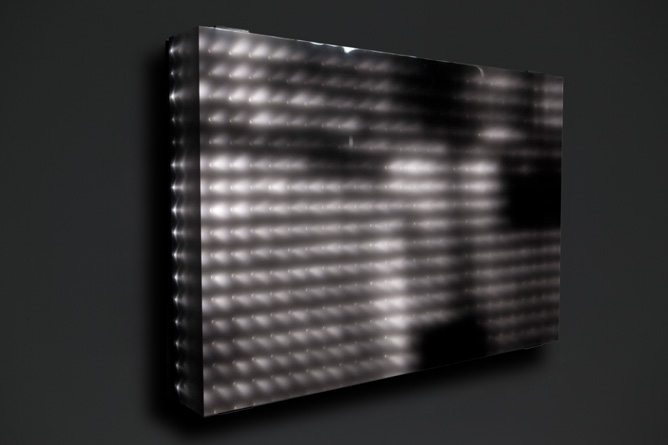
In this week’s reading from New Philosophy and New Media (2006), Mark B.N. Hansen lays out the foundations for his theory of new media art, rooted in a phenomenological, Bergsonian understanding of the way artists and audiences engage with such data. The work of photographer, digital video, new media and installation artist Jim Campbell engages and illustrates many of Hansen’s ideas regarding embodied vision, and its role in framing the flow of digital flow of data for every viewer, in his current exhibition Exploded View (through May 22, 2010) at Bryce Wolkowitz Gallery. Arguing for the radical newness of new media art in the face of dismissive evaluations like those of Rosalind Krauss and Liev Manovich, Hansen writes, “with the flexibility brought about by digitization, there occurs a displacement of the framing function of medial interfaces back onto the body from which they themselves originally sprang” (22, emphasis original). For Hansen, the content of a new media artwork, transformed into raw binary data, is increasingly liberated from the material requirements of one particular medium or support like a canvas or photographic print. Consequently, the body takes on the role of delimiting the scope and scale of the work’s data or, as Hansen writes, “as media lose their material specificity, the body takes on a more prominent function as the selective processor of information” (22).
In Campbell’s work, particularly the titular centerpiece of his new exhibition, the information on display makes viewers irrevocably aware of their role in framing and processing of the piece. Furthermore, “Exploded View”undermines the incompatibility that Hansen posits between his interpretation of Bergson and Deleuze’s willingness to grant a certain autonomy to the support through which artworks are presented to viewers (8). Campbell’s practice involves the juxtaposition of moving and static images, the presentation of digital video footage in forms and framing devices that challenge our ability to perceive any figurative data at all, and a foregrounding of the comparatively simple pixel and LED units that make up these visually complex works. In many pieces, such as “Montgomery Street Pause” (2010), the work seen from a distance shows a horizontal, cinematic street scene in black and white made up of over a thousand LED lights under plexiglass playing in a loop that pauses at its midway point. Upon closer inspection or from an askew angle, however, the figurative image disappears and becomes a fluctuating, abstract pattern of miniscule individual lights of varying intensity. The piece suggests one way we might view its data, while allowing for the body “to deploy its sensorimotor power to create the unpredictable, the new”(7).
“Exploded View”(2010) maximizes the role of viewers’ bodies. From one very specific position, the strings of LED bulbs hanging in the darkened gallery like holiday garlands coalesce to reveal endlessly looping footage of a silhouette walking in a circle, falling, getting up, walking further, falling, getting back up and so on. There is no suggestion that this is the one, “correct”way to view the piece: viewers move around the work freely, apprehending it as an abstract flow of lights not unlike rainfall from certain angles, a kind of digital interpretation of a drip painting in four dimensions. The piece, as Hansen writes, “introduces the power of creativity into the sensorimotor body”(8) just as it asserts the autonomy of this very specific material presentation of this particular video loop; namely the custom LED structure that Campbell, an MIT-trained electrical engineer and mathematician, designed for the piece. Like the figure in the video it displays from that one specific angle, we circle “Exploded View”encourages us to move around it, apprehending it from different angles and distances. If occasionally we fall into the one spot from which we see the figure running and falling, Campbell’s light and video installation encourages us to keep moving. In doing so, “Exploded View”problematizes Hansen’s opposition between the frame and embodied perception (8). The piece, like so many of Campbell’s works, foregrounds the process by which “the image becomes a merely contingent configuration of numerical values” (9), and in this particular configuration as pixels displayed with LED lights it frames one specific form this data can take, while empowering viewers to frame it differently. It frames a digital image that then “explodes the frame” (35). Rather than suggesting a limitation of Hansen’s work, this additional wrinkle in his new media theory demonstrates the rich complexity of emerging contemporary art practices such as Campbell’s.
This is a video of an earlier piece by Jim Campbell, "White Circle" (2000), which shows how his works go from figurative to abstract based on the angle and proximity of the viewer.
What follows will be a collective blog dedicated to mapping a number of connections between the writings of the French philosopher Gilles Deleuze, the work of various media theorists, and contemporary art practice. It was begun to coincide with the course "Art After Deleuze: From Architecture to New Media", in the Media Studies MA program at The New School (Spring 2010).