Listening and looking at Caldwell’s and Ariel’s last presentations got me to thinking about the relationship of the natural to the digital. It is still the still image, more than any other form of media, that I feel is the outward representation of that brink and process. If perception and time all play a relevant part in the play of time and space (and how that interplay is (or can be) perceived) is central, then I think the still image is as well.
Hansen states that, “In this posthuman perceptual regime, the selection of information is no longer performed exclusively or even primarily by the human component (the body-brain as a center of indetermination)” (99), and I remember looking at that quote as I sat through Ariel’s really well-conceived presentation.
I wonder if the still image might best be reconsidered almost as a GUI, a basis from which to launch into the studies or applications or processes of human perception. The ability to drill down, to capture detail, to edit, provide frames of reference, to contextualize, to link… these are the things that have traditionally been fulfilled by the still image.For all of these things the still image could make for a launch point.
The natural world even provides for framesets through bioregions, continents, bodies of water, planets, etc. All of these things are energized through light, and a split second “framing” of that light might allow for an ability to realize the greater schemes that allow the natural world to work, and might serve as a blueprint for a truer media ecology of balance and flow.
During our discussion on Wednesday one of the major shortcomings we found in Mark B. N. Hansen's New Philosophy for New Media (2006) was the absence of any engagement with video games. This struck us as especially problematic since his whole project seemed to be a consideration of the ways that qualitatively new media allow us to engage with them in an affective, embodied manner, and this certainly sounds like the kind of experience we have whenever we play a video game, be it an old coin-operated Pacman arcade game or a brand new Wii game at home or World of Warcraft on a computer. Surely Hansen would not be able to liken this activity to the so-called "enforced passivity" of the cinema that he seems so resolved to criticize. But then how would he be able to maintain a distance (as he would presumably want to do) between the work of Jeffrey Shaw that he is so committed to, and something like Second Life, Halo, or even Tetris? I think we might extract and extrapolate some (relatively positive) evaluation of video games from Hansen's critique of Liev Manovich's The Language of the New Media (2001), and the treatment of virtual reality (VR) therein, near the end of chapter one of New Philosophy for New Media.
In this passage Hansen criticizes Manovich's evaluation of VR for failing to fully take into account the embodied experience of the user during and despite the experience of being also virtually embodied, or virtualized. He asks: "Can the reality effect of telepresence be understood without an account of the physicality of the virtualized body?" (40-41) He suggests, in other words, that new media such as VR enable the user to be doubly embodied, both in the "original" space of the virtualizing interface or console and within the virtual world, in a digitized body. While Manovich suggests that the latter nullifies the former for the duration of the VR experience, Hansen argues that both must be partial and simultaneous, leading him to propose what seems a very radical (and very Deleuzian) realignment of the conventional opposition between representation and simulation, one that can be useful for constructing a Hansenian theory of the video game. He writes of Manovich: "the example of telepresence underscores the limitations of his general distinction between representation and simulation and suggests the necessity of triangulating this binary with a third term, namely, hallucination (by which I mean... that the embodied mind actually creates what it sees)" (41, emphasis original). One final quotation (in which we might substitute "video game" for "VR" to fully understand how these comments apply to the former medium): "that explains the capacity for the VR interface to couple our bodies with (almost) any arbitrary space, and not just spaces that are contiguous with the physical space we happen to occupy or even spaces like those we typically occupy" (41). This triangulating, hallucinatory property that Hansen invests in VR can very easily be seen as the starting point for his (perhaps surprisingly positive) evaluation of video games.
Video games, like VR, must then trigger this phenomenon of being in a doubly embodied, hallucinatory state, activating a virtualized world while still remaining an affective body within the world of the gaming interface. Certainly the increasingly frequent appearance of artist-designed video games in art spaces corroborates this characterization. In the exhibition The Generational: Younger Than Jesus at the New Museum last year, video game artist Mark Essen presented a game of his called Flywrench (2007), in which the player uses a controller to navigate a flying wrench through a series of increasingly labyrinthine spaces while trying to keep the fragile object from shattering. The unique telepresence of this game takes us to an environment that is certainly not "like those we typically occupy," requiring us to assume the position of a typically inanimate object (a wrench) endowed with the superhuman ability of flight. Playing the game, however, also meant standing in a museum gallery (there was no seating, perhaps to discourage visitors for hogging the one controller for too long) surrounded by other visitors, some of whom might be watching you play, hearing sounds from nearby installations and videos. Perhaps not an ideal gaming environment, the Flywrench installation illustrated Hansen's phenomena of triangulation and hallucination in a decidedly active, rather than passive, setting.
An installation at last spring's Offf Festival by the Spanish design firm Multitouch Barcelona pushed this capacity for simultaneous, multiple embodiments to the extreme, creating a wall-sized projection of the vintage arcade game Space Invaders (see video at the end of this post). Gallery-goers played the game not by pushing buttons on a controller or joystick, but by throwing projectiles like tennis balls at the projected images on the wall, where a sensory surface detected the hit, destroying the enemy ship, if there was one, in that spot. Anything but passive, this throwing game has the further advantage of being a multi-player experience, adding a sense of temporary, communal embodiment very different from the solitary VR experience that Hansen describes.
Another video game artist, Erik Svedang, has created a very immersive, but just as graphically simple gaming environment called Pixel Cave Adventure (2007, pictured at top), in which gamers play within a small cube surrounded by four screens, directing a small human figure who moves around the panoramic maze surrounding the player. Parallels to the work of Jeffrey Shaw, as discussed by Hansen, are inevitable, though here the simultaneity of embodiments is perhaps more extreme, allowing the gamer to control a solitary humanoid character while at the same time having to move and turn around in the claustrophobic space of the gaming cube.
These examples of how we might imagine Hansen's hallucinatory theory of VR being applied to video games all involve site-specific installations, but a simpler game that exists online for free might demonstrates the VR-video game analogy as well. First-Person Tetris begins much like the original game, presenting the gamer with a vertical, rectangular space and falling blocks that must be arranged to create solid lines. The space of the game is surrounded by a conventional living room setting with television, carpeting, a houseplant and video game console. But as the pieces move downwards so does the entire screen. Rotating pieces to fit them into the increasingly complex geometric gaps makes the entire screen rotate. As the game's title suggests, we are challenged to assume the point of view of these abstract blocks of forms and color, a perspective that stands in sharp contrast to our embodied presence in front of a computer screen. Aside from provoking a surprisingly acute sense of Hansen's hallucinatory double embodiment, First-Person Tetris is liable to provoke nausea, pushing our capacity to inhabit both the virtualized and physical spaces at once nearly to its breaking point. Such innovative video games offer extremely interesting and promising activations of Hansen's concept of multiple embodiments and the hallucinatory relation between representation and the virtual in VR. Though he never addresses the potential of video games for triggering qualitatively new experiences and embodiments, we can surmise of his engagement with VR that he may have identified a surprisingly optimistic potential in this new medium.
-Ben Sutton
Here is a short video of the interactive, wall-sized Space Invaders projection by Multitouch Barcelona at the 2009 Offf Festival:
In this week’s reading from New Philosophy and New Media (2006), Mark B.N. Hansen lays out the foundations for his theory of new media art, rooted in a phenomenological, Bergsonian understanding of the way artists and audiences engage with such data. The work of photographer, digital video, new media and installation artist Jim Campbell engages and illustrates many of Hansen’s ideas regarding embodied vision, and its role in framing the flow of digital flow of data for every viewer, in his current exhibition Exploded View (through May 22, 2010) at Bryce Wolkowitz Gallery. Arguing for the radical newness of new media art in the face of dismissive evaluations like those of Rosalind Krauss and Liev Manovich, Hansen writes, “with the flexibility brought about by digitization, there occurs a displacement of the framing function of medial interfaces back onto the body from which they themselves originally sprang” (22, emphasis original). For Hansen, the content of a new media artwork, transformed into raw binary data, is increasingly liberated from the material requirements of one particular medium or support like a canvas or photographic print. Consequently, the body takes on the role of delimiting the scope and scale of the work’s data or, as Hansen writes, “as media lose their material specificity, the body takes on a more prominent function as the selective processor of information” (22).
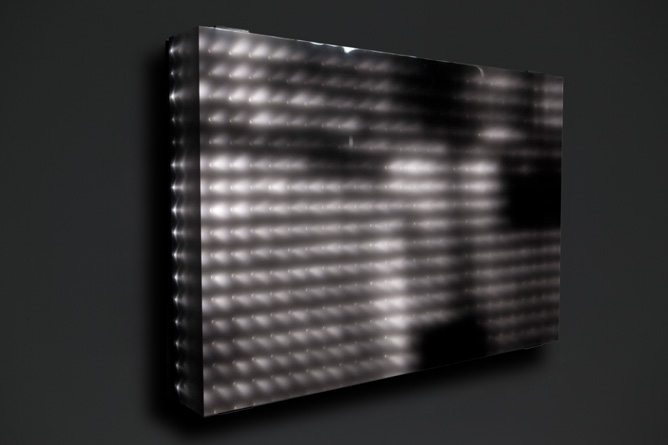
In Campbell’s work, particularly the titular centerpiece of his new exhibition, the information on display makes viewers irrevocably aware of their role in framing and processing of the piece. Furthermore, “Exploded View”undermines the incompatibility that Hansen posits between his interpretation of Bergson and Deleuze’s willingness to grant a certain autonomy to the support through which artworks are presented to viewers (8). Campbell’s practice involves the juxtaposition of moving and static images, the presentation of digital video footage in forms and framing devices that challenge our ability to perceive any figurative data at all, and a foregrounding of the comparatively simple pixel and LED units that make up these visually complex works. In many pieces, such as “Montgomery Street Pause” (2010), the work seen from a distance shows a horizontal, cinematic street scene in black and white made up of over a thousand LED lights under plexiglass playing in a loop that pauses at its midway point. Upon closer inspection or from an askew angle, however, the figurative image disappears and becomes a fluctuating, abstract pattern of miniscule individual lights of varying intensity. The piece suggests one way we might view its data, while allowing for the body “to deploy its sensorimotor power to create the unpredictable, the new”(7).
“Exploded View”(2010) maximizes the role of viewers’ bodies. From one very specific position, the strings of LED bulbs hanging in the darkened gallery like holiday garlands coalesce to reveal endlessly looping footage of a silhouette walking in a circle, falling, getting up, walking further, falling, getting back up and so on. There is no suggestion that this is the one, “correct”way to view the piece: viewers move around the work freely, apprehending it as an abstract flow of lights not unlike rainfall from certain angles, a kind of digital interpretation of a drip painting in four dimensions. The piece, as Hansen writes, “introduces the power of creativity into the sensorimotor body”(8) just as it asserts the autonomy of this very specific material presentation of this particular video loop; namely the custom LED structure that Campbell, an MIT-trained electrical engineer and mathematician, designed for the piece. Like the figure in the video it displays from that one specific angle, we circle “Exploded View”encourages us to move around it, apprehending it from different angles and distances. If occasionally we fall into the one spot from which we see the figure running and falling, Campbell’s light and video installation encourages us to keep moving. In doing so, “Exploded View”problematizes Hansen’s opposition between the frame and embodied perception (8). The piece, like so many of Campbell’s works, foregrounds the process by which “the image becomes a merely contingent configuration of numerical values” (9), and in this particular configuration as pixels displayed with LED lights it frames one specific form this data can take, while empowering viewers to frame it differently. It frames a digital image that then “explodes the frame” (35). Rather than suggesting a limitation of Hansen’s work, this additional wrinkle in his new media theory demonstrates the rich complexity of emerging contemporary art practices such as Campbell’s.
This is a video of an earlier piece by Jim Campbell, "White Circle" (2000), which shows how his works go from figurative to abstract based on the angle and proximity of the viewer.
In Postproduction, Nicolas Bourriaud discusses the process of appropriation in contemporary art. He describes postproduction as an engagement with the stages of consumption and production. Through postproduction, artists demonstrate that consumption does not mean the end of production and that these states are intertwined. For Bourriaud, the artist suggests alternative modes of living that subvert the dominant narrative of “active producer” and “passive consumer”. For the purpose of this post I would like to briefly explore how the landscape of production/consumption has changed since Postproduction was written in 2002 through the work of two contemporary artists: Oliver Laric and Michael Robinson.
With the popularization of sites such as Youtube and Flicker the idea of consumption as the end point of production has been significantly, if not fatally, wounded. Whether remixed, mashed up, or simply reposted consumers no longer keep the products of their consumption to themselves. The download culture of the Napster era is now complemented by the upload culture of the Youtube era. Through the redistribution of the means of distribution, cultural products long assumed dead-and-gone are given a second life and are projected into what often seems like an endless echo chamber of comments, remixes, reposts, and remakes. Michael Robinson and Oliver Laric explore the new forms of consumption and production that arise in this environment.
For the sake of simplicity I would like to assign Michael Robinson’s work to the realm of Youtube consumption and Oliver Laric’s work to Youtube production, although these designations certainly bleed into each other. In an interview with Incite!Robinson describes his work as engaging and subverting ideas of nostalgia and beauty by embodying them. In works such as Hold Me Now (2008) and Light is Waiting (2007), Robinson evokes the nostalgia of instant, unimpeded access to childhood cultural products by appropriating and manipulating videos and songs from the 80s and 90s. If Jeff Koons’ work evokes the creation of desire by 80s’ advertising in order to examine it, as Bourriaud claims, then Robinson’s work evokes the creation of nostalgia (a desire for past beauty) that is created by Youtube’s endless recycling of past cultures. Robinson simultaneously evokes and alienates us from the nostalgia through which we consume Youtube videos. His mixing of the comforting and the kitschy with the strange and the mysterious creates a tension and confusion between the apprehension of the surface and a feeling of depth. (Michael Robinson’s videos can all be found online here: http://www.poisonberries.net/films.html)
If Youtube has broken down the hierarchical modes of consumption and production, Oliver Laric’s 50 50 (2007) takes a stab at redefining what has replaced them. 50 50 accumulates a range of fan-made renditions of 50 Cent’s songs that have been uploaded to Youtube. In this piece the hierarchy of past distributions of culture is brought into conflict with the shape of contemporary forms. Each contributor is given equal say, broadcasting their personal consumption of 50 Cent for all to see. What 50 50 makes abundantly clear is that consumption is no longer private, it no longer stays in the living room while watching TV, or in the gallery while viewing a painting, or in your bedroom while blasting your music. Instead, it is rebroadcast, redistributed, and reconsumed. By bringing these broadcasts together, Laric shows us the face of a new consumer, who is equally aware of their production as their consumption.
What this video also makes abundantly clear is the resilience of top down model of production and consumption. If Laric shows us the power of new technologies for rebroadcasting, 50 50 also displays the homogenization of what we choose to broadcast. The piece points to the revolutionary potential of the medium to change where and what we consume, but also the possible downfall for this potential, in which we simply rebroadcast what we receive from the top. As the name might suggest, 50 50 is equally optimistic and pessimistic about the changes in production consumption which Youtube and other new forms of online sharing can bring.
What follows will be a collective blog dedicated to mapping a number of connections between the writings of the French philosopher Gilles Deleuze, the work of various media theorists, and contemporary art practice. It was begun to coincide with the course "Art After Deleuze: From Architecture to New Media", in the Media Studies MA program at The New School (Spring 2010).